
American burnweed
Erechtites hieraciifolius
Description
How to tell it apart
American burnweed (Erechtites hieraciifolius) is an annual herbaceous plant belonging to the Asteraceae family. It is characterized by an erect, often branched stem that can reach heights of up to 2 meters.
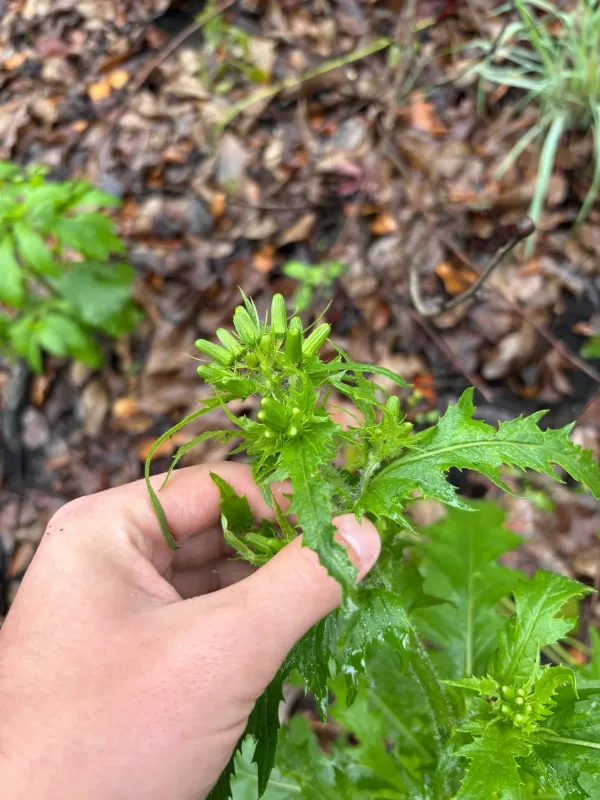
The leaves are lanceolate or oblong, with serrated margins, resembling those of hawkweed. While the lower leaves often narrow into a petiole, the upper leaves are sessile and partially clasp the stem.
The inflorescences consist of numerous small, cylindrical flower heads arranged in an open, paniculate cluster. The individual florets are tubular and greenish-yellow or whitish in color.
Each fruit is a cylindrical achene topped with a copious, white pappus, which allows the seeds to be easily dispersed by the wind over long distances.
The plant possesses a well-developed taproot system, enabling it to establish itself rapidly in loose or disturbed soil environments.
Where it grows
This weed is a typical colonizer of disturbed sites, frequently appearing in clear-cut forests, burned-over areas, roadsides, and abandoned agricultural fields.
In farming, it acts as a troublesome weed in row crop systems, vegetable gardens, and any areas where the soil has been turned or cleared, reducing natural competition.
The species exhibits high ecological plasticity, thriving in a variety of soil types, ranging from moist, nutrient-rich soils to disturbed gravelly substrates.
It is particularly problematic in humid, damp locations where its growth rate exceeds that of many native species or traditional forage crops.
Due to its efficient seed dispersal mechanism, the plant quickly dominates new areas, making it a significant pest in both industrial and small-scale agriculture.
Harm it causes
The primary harm caused by American burnweed is its aggressive competition with crop plants for water, sunlight, and essential soil nutrients during critical growth stages.
By forming dense patches, it shades out smaller crops, significantly reducing photosynthetic efficiency and overall biomass accumulation in the infested fields.
The tall, robust growth of this weed hinders mechanical agricultural operations, causing operational downtime and potential damage to harvesting machinery.
If left unmanaged, its rapid spread can lead to heavy seed bank accumulation in the soil, requiring multi-year intervention to reclaim the field for optimal production.
In nursery settings, it suppresses the growth of young trees or seedlings, posing a threat to forest regeneration efforts and nursery profitability.
How to control
Agronomic control strategies involve deep tillage and frequent cultivation of inter-row spaces to disrupt the root systems and kill seedlings before they reach reproductive maturity.
Maintaining strong, healthy crop stands through proper fertilization and crop rotation is vital to ensure that crops shade out and outcompete weed seedlings.
Chemical control utilizing selective post-emergence herbicides is effective if applied early in the season when the plant is in its vegetative rosette stage.
Sanitation practices, such as mowing field borders and surrounding non-cropped areas, prevent the influx of wind-borne seeds into the primary production zones.
- Monitor fields consistently during the early spring.
- Implement crop rotation to break the weed's life cycle.
- Apply systemic herbicides precisely according to label instructions.
Taxonomy
- Latin name
- Erechtites hieraciifolius
- Family
- Сложноцветные (астровые)
- EPPO code
- EREHI