
Amplexicaul hawkweed
Hieracium amplexicaule
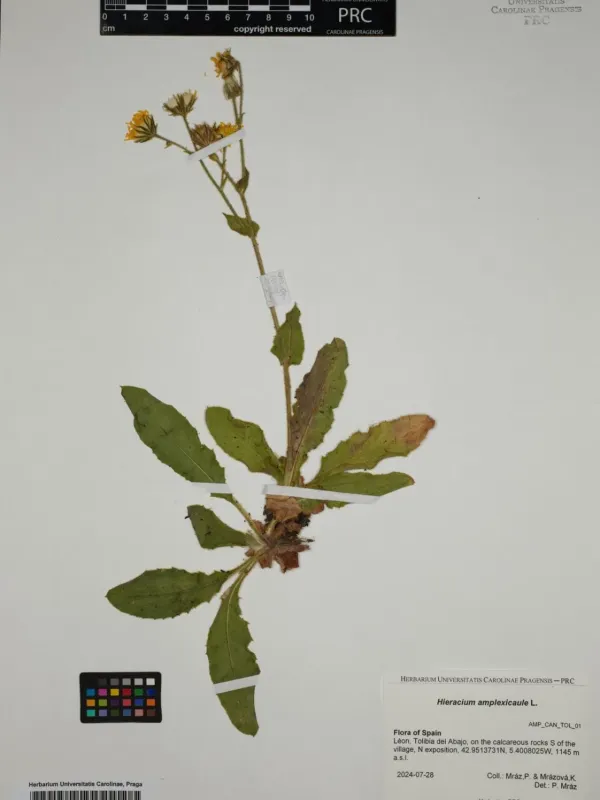
Description
How to tell it apart
Amplexicaul hawkweed (Hieracium amplexicaule) is a perennial herbaceous plant belonging to the Asteraceae family. It is characterized by a robust root system and glandular hair covering its stems and foliage.
The defining botanical feature is its amplexicaul (stem-clasping) leaves, which tightly wrap around the main stem at their base. The leaf shape is typically oval or oblong with serrated edges.
The inflorescence consists of flower heads with bright yellow ligulate florets. The plant reproduces via seeds and spreads vegetatively, making it resilient in various agricultural settings.
Stems reach heights of 20 to 50 cm and feel sticky to the touch due to abundant glandular hairs. Flowering occurs in mid-summer, followed by the development of achenes with pappus for wind dispersal.
It is classified as a persistent perennial weed that can rapidly colonize disturbed soils and compete aggressively with agricultural crops for space and resources.
Where it grows
This species thrives in rocky, dry soils and is commonly found on mountain slopes, abandoned fields, and pastures. In agriculture, it poses a risk to forage crops and row crops.
It typically inhabits areas with soil disturbance where native vegetation or established crops are unable to provide effective competitive pressure against invasive weeds.
Amplexicaul hawkweed is highly cold-tolerant, allowing it to survive harsh winter conditions and initiate growth early in the spring before most crop species emerge.
Often found in foothill regions, the weed can easily spread to nearby farmland through wind-dispersed seeds or contaminated equipment used in fields.
While it prefers full sunlight, it shows significant phenotypic plasticity, allowing it to persist in partially shaded environments, including the edges of densely planted crops.
Harm it causes
The primary agricultural impact is severe competition for essential nutrients, water, and sunlight, which can significantly reduce the yield and quality of commercial crops.
The extensive root system depletes soil moisture rapidly, putting cultivated plants at a disadvantage, especially during periods of low precipitation or summer drought.
In grazing lands, it degrades forage quality because the sticky glandular hairs and bitter taste make it unpalatable for livestock, leading to reduced grazing efficiency.
The weed interferes with mechanical harvesting operations; its sticky residue can clog harvesting machinery, leading to increased maintenance and downtime during the harvest season.
It also serves as a host reservoir for various pests and fungal pathogens, which can migrate from the weed patches to infect healthy crops in the vicinity.
How to control
Effective agrotechnical control relies on deep tillage and discing, which help to cut the rhizomes and exhaust the weed's carbohydrate reserves over several growing seasons.
Crop rotation is essential; incorporating competitive crops that provide rapid canopy closure can help suppress the weed by limiting its access to sunlight.
Chemical control usually requires the application of systemic herbicides effective against perennial broadleaf weeds, ensuring the product reaches the root system.
Application during the rosette stage or in late autumn, when nutrients are being translocated to the roots, typically yields the best long-term control results.
- Frequent clearing of field borders to prevent seed dispersal.
- Use of clean, high-quality seeds to avoid new infestations.
- Mowing before the plant reaches the flowering or seed-set stage.
- Strategic herbicide application based on local agricultural guidelines.
Taxonomy
- Latin name
- Hieracium amplexicaule
- Family
- Сложноцветные (астровые)
- EPPO code
- HIEAM