
Baccharoides anthelmintica
Baccharoides anthelmintica
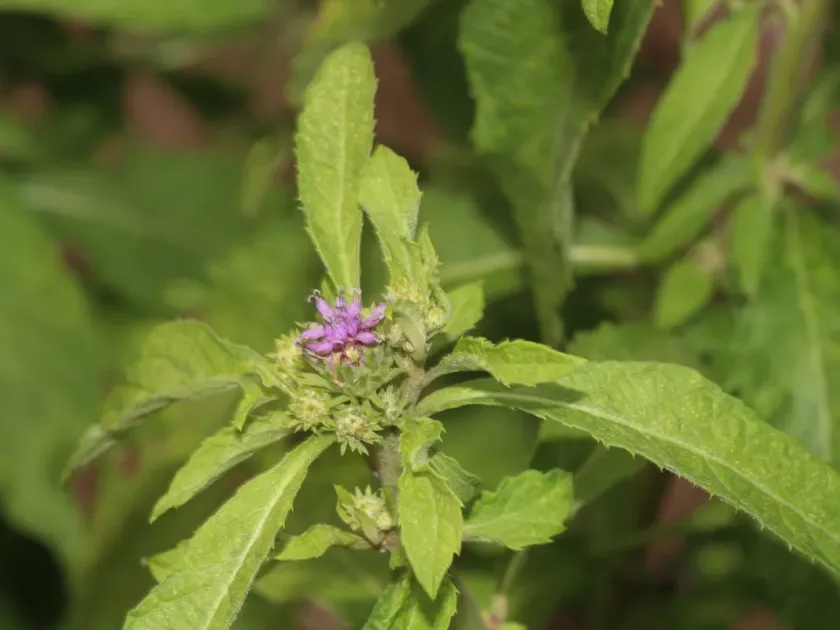
Description
How to tell it apart
Baccharoides anthelmintica, formerly recognized as Vernonia anthelmintica, is a member of the Asteraceae family. This annual herbaceous plant is known for its robust growth habit and is a frequent invader in tropical and subtropical regions.
The plant typically features a straight, branched stem that can reach heights of up to one meter. Its leaves are alternate, elongated, and possess serrated margins, which are useful traits for field identification.
The inflorescences consist of flower heads (capitula) composed mostly of tubular florets, typically displaying shades of purple or pale violet. These heads are clustered at the tips of branches.
Its fruits are cypselae (seeds) equipped with a pappus, a tuft of hairs that allows for easy wind dispersal. This mechanism contributes to its success as a colonizing species in disturbed soil.
The root system is a well-developed taproot that provides the plant with stability and the ability to extract water and nutrients effectively even in competition with neighboring plants.
Where it grows
Baccharoides anthelmintica is native to various parts of Asia and has spread to numerous other regions as a weed. It frequently occupies niches in agricultural lands, thriving in fields of cereals, legumes, and vegetable crops.
It favors fertile, well-drained soils but demonstrates high adaptability to various soil types, including those with moderate moisture levels. It is commonly found on field borders, wasteland, and alongside irrigation ditches.
The plant is highly opportunistic and quickly colonizes areas where the soil has been disturbed. Its presence is often high in fields where soil tillage is insufficient or abandoned for a short period.
Due to its high environmental plasticity, the weed successfully persists in both managed fields and adjacent non-crop areas, acting as a constant source of re-infestation for agricultural land.
It shows rapid development during the early summer months, taking advantage of high light intensity and adequate moisture to quickly outgrow slow-starting crops.
Harm it causes
The primary damage caused by this weed is resource competition. It competes aggressively for nitrogen, phosphorus, and soil moisture, which significantly limits the growth potential of target crops.
Through its dense foliage, it creates substantial shading effects. This competitive exclusion suppresses the photosynthesis of young crop seedlings, often leading to reduced plant height and biomass production.
Baccharoides anthelmintica acts as a reservoir host for various pests and plant diseases, which can spread to commercial crops, increasing the cost of integrated pest management.
The presence of this weed during harvest complicates mechanical operations, as the plant biomass can clog harvesting equipment and increase the moisture content of the grain, necessitating extra drying.
Yield losses can be significant in areas with high infestation rates, with competitive pressure from this weed potentially reducing overall crop productivity by 20% to 40%.
How to control
Effective management begins with mechanical control methods, such as deep plowing. This buries the weed seeds to a depth that prevents them from germinating and emerging successfully.
Cultural practices, such as maintaining a proper crop rotation, are essential. Crops that grow quickly and close the canopy early effectively suppress the growth of this light-dependent weed.
Inter-row cultivation is highly effective when performed during the early growth stages, as it destroys young plants before they reach their reproductive phase and produce seeds.
Chemical control involves the application of selective systemic herbicides. The choice of herbicide should be matched to the specific crop, with broad-spectrum systemic agents often providing the best results.
- Regular monitoring of field edges for seed sources.
- Implementation of weed-free buffer zones.
- Use of competitive crop varieties.
- Integrated herbicide programs to prevent resistance development.
Taxonomy
- Latin name
- Baccharoides anthelmintica
- Family
- Сложноцветные (астровые)
- EPPO code
- VENAN