
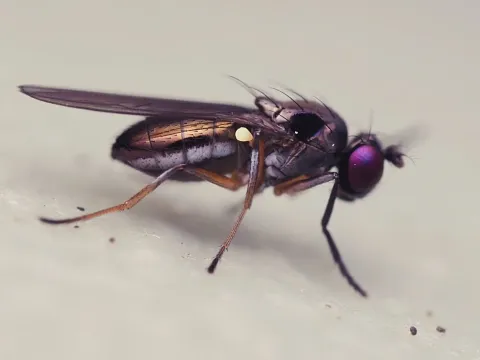
Hydrellia
Hydrellia
Hydrellia is a genus of small flies belonging to the Ephydridae family, commonly known as shore flies. The most significant member from an agricultural perspective is the rice leafminer.
What the section contains
Hydrellia
Adult flies are small, typically measuring between 2 to 3 millimeters in length. They are characterized by a greyish body and prominent, widely-spaced eyes, which are diagnostic for this group.
The larvae are specialized leafminers. They lack a distinct head capsule and have a slender, translucent white or pale yellow body that allows them to move through plant tissues efficiently.
The life cycle is moisture-dependent, comprising the egg, larva, pupa, and adult stages. Under favorable warm conditions, the flies can complete their life cycle in just a few weeks.
Adults typically overwinter in plant debris or sheltered areas near water sources, emerging when temperatures rise in the spring to begin laying eggs on young foliage.
Hydrellia species primarily target rice crops. They thrive in environments where water management is inconsistent or where weeds are abundant along the irrigation canals.
The larvae feed on the mesophyll tissue within the leaf blade. By creating tunnels or "mines," they disrupt the plant's ability to photosynthesize effectively.
While rice is the primary host, other wetland grasses may also be infested, serving as alternative hosts that maintain the pest population in the agroecosystem.
Damage is most severe during the seedling and early tillering stages. Stunted growth, yellowing foliage, and plant death are common consequences of heavy infestation.
Significant economic losses occur when environmental conditions promote rapid pest development, often leading to reduced stand density and diminished overall yield.
The presence of Hydrellia is first indicated by narrow, serpentine mines on the leaves. These mines are typically visible on the upper surface of the leaf blade.
As the larvae feed, the mines expand and merge, causing the affected leaf tissue to turn yellow, wither, and eventually die prematurely.
Upon closer inspection, growers can often observe the small, translucent larvae inside the tunnels or find fecal pellets deposited along the leaf mines.
Infested seedlings appear weakened and may lean or droop. In severe cases, the entire canopy of a rice field can show a patchy, yellowish-brown discoloration.
The exit holes created by emerging adults are also visible as small, longitudinal ruptures on the surface of the leaf, signaling that the generation has completed its cycle.
Water management is the primary cultural control method. Maintaining sufficient water levels in rice paddies can drown larvae and prevent successful pupation.
Sanitation of irrigation systems and surrounding fields is critical. Removing host weeds prevents the pest from building up populations before migrating to the crop.
Chemical control involving systemic insecticides is applied when the pest density exceeds economic thresholds, ensuring the chemical reaches the larvae inside the leaf tissue.
Biological control efforts focus on conserving natural predators and parasitoids that hunt larvae and eggs, providing a sustainable way to limit population explosions.
- Timely flooding of paddy fields to disrupt larval development.
- Removal of weed hosts from field margins and ditches.
- Use of certified seeds treated with systemic insecticides.
- Monitoring adult population trends using sticky traps.