
Rice leaf miner
Hydrellia philippina
Description
How to identify
The rice leaf miner (Hydrellia philippina) is a small dipteran insect belonging to the family Ephydridae, commonly known as shore flies. It is a well-known pest in Asian rice-growing regions.
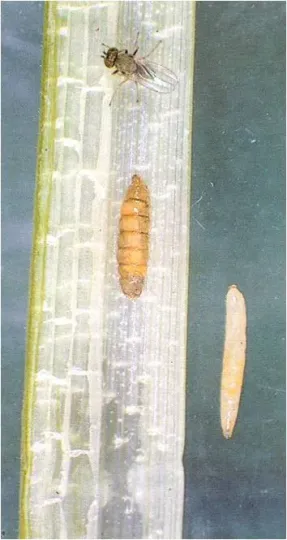
Adult flies are tiny, typically measuring 2 to 3 mm in length. They are characterized by a dark grey or brownish coloration, making them difficult to spot on the plant foliage.
The life cycle encompasses four stages: egg, larva, pupa, and adult. The fly is highly adapted to humid environments, particularly the water-logged conditions of rice paddies.
The larvae are pale, cylindrical, and feed exclusively on the inner tissues of the leaves, while the pupae are typically found attached to the leaf sheath or submerged tissues.
Adults are active flyers and are attracted to fields with succulent, young vegetation where they can deposit their eggs efficiently.
What it damages
The primary host for this pest is rice (Oryza sativa). Larvae burrow into the leaf tissues to feed on the mesophyll, creating narrow channels known as mines.
While rice is the preferred host, the insect can also survive on various grassy weeds found near irrigation ditches and along the margins of rice fields.
The most severe damage occurs during the seedling stage. Heavy infestations can cause significant loss of leaf area, reducing the plant's ability to perform photosynthesis.
In cases of severe outbreak, the young rice seedlings may wither and die, leading to reduced plant density and the need for replanting.
Chronic infestation throughout the vegetative stage can also lead to stunted plants and delayed maturity, impacting overall harvest volume.
When it appears
The activity of the rice leaf miner is highly dependent on climate, with population growth accelerating in warm, humid conditions typical of rice cultivation.
The pest often emerges early in the season, right after the transplantation of rice seedlings, which provides the necessary food source for the first generations.
Multiple generations can occur within a single cropping season, allowing the population to build up rapidly if conditions remain favorable.
Outbreaks are frequently correlated with periods of high rainfall or inadequate water management that sustains high humidity in the canopy.
As the season draws to a close, the insects transition to dormant phases or find shelter in weeds and debris, surviving until the next planting cycle.
Signs of infestation
The diagnostic sign of infestation is the appearance of distinct white or transparent stripes on the leaves, which are the larval feeding tunnels (mines).
Damaged leaves often turn yellow at the tips, eventually curling and drying out due to the destruction of internal tissues by the larvae.
Field observation often reveals patches of stunted, yellowing rice plants amidst healthier sections of the crop.
Careful inspection of the leaf surface may show small black dots, which are the excrement left behind by the larvae as they mine the leaf.
- White, linear tunnels on leaves.
- Yellowing and drying of leaf tips.
- Stunted plant growth and reduced vigor.
- Premature leaf senescence.
Control measures
Water management is the most critical cultural practice; temporarily draining the rice fields can significantly reduce the survival rate of the larvae.
Maintaining clean fields by removing alternative weed hosts prevents the build-up of the population between planting seasons.
Chemical control involving systemic insecticides is recommended when the infestation level exceeds the economic threshold to prevent substantial yield loss.
Encouraging the presence of natural predators and parasitoids, such as small wasps, is an effective strategy for long-term population suppression.
Selecting rice varieties with faster early growth or thicker leaves can make the plant less susceptible to initial damage during the critical early growth phases.
Taxonomy
- Latin name
- Hydrellia philippina
- Order
- Diptera (flies)
- Family
- Ephydridae
- EPPO code
- HYDRPH
Discussion
No discussions yet — be the first.