

MOSCOW TRANSPARENCY
BOTANIChESKIJ SAD MGU IM.M.V.LOMONOSOVA
Sea Buckthorn
0
0
·
75
1 offer
245.42 €per pack
Buy
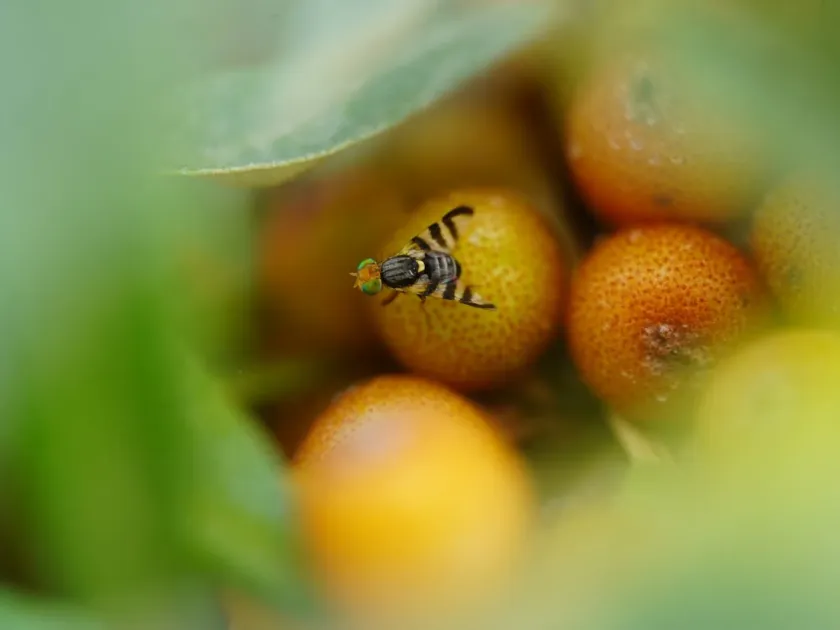
The sea buckthorn fly (Latin: Rhagoletis batava) is a member of the Tephritidae family, order Diptera. This small insect measures approximately 3–5 mm in length and is distinguished by dark banding patterns on its wings.
Adult flies typically have a black, glossy body. Their eyes exhibit a vivid greenish or golden iridescence, serving as a key diagnostic feature to differentiate them from common house flies.
The larvae are about 5–7 mm long, cylindrical, and legless, with a creamy white appearance typical of many fruit-infesting fly larvae.
The pupae, or puparia, are barrel-shaped and dark brown in color. The pest spends the majority of its life cycle in this dormant stage within the soil.
Adult flies emerge once ambient temperatures stabilize above 18°C, often coinciding with the initial development phase of the host fruit.
The primary host for this pest is the common sea buckthorn (Hippophae rhamnoides). Adult flies feed on fruit juices and aphid honeydew to reach sexual maturity.
Larvae develop exclusively inside the sea buckthorn berries. By consuming the internal pulp, they destroy the berry's structure, rendering the harvest commercially useless.
The damage is widespread in both cultivated plantations and wild populations. Infestation rates can reach 80–90% if effective management strategies are not implemented.
Early and mid-season varieties are generally at higher risk, as their ripening period aligns more closely with the peak emergence and oviposition of the adult flies.
Affected fruit is entirely inedible and unsuitable for processing due to the presence of larvae and associated decay of the fruit flesh.
The mass emergence of adults from the soil typically occurs when berries begin to turn orange, usually from late June to early July.
The active flight period of the adults lasts between 30 and 40 days. During this time, females actively search for suitable berries to lay their eggs.
Oviposition is staggered; a female pierces the berry skin to deposit a single egg, with one female capable of laying up to 300 eggs throughout the season.
The larval stage inside the berry lasts for approximately 20–25 days. Once fully grown, the larvae chew an exit hole and drop to the ground.
After exiting the fruit, larvae burrow 2–5 cm into the soil to pupate, where they overwinter until the following spring.
The earliest symptom of an infestation is the shriveling of the berries. Infested fruit loses its natural luster and becomes soft and sponge-like to the touch.
Close inspection of the fruit surface reveals tiny dark punctures or marks at the site where the female laid her eggs.
Infested berries often show signs of premature discoloration, turning prematurely purple or brown, which contrasts sharply with healthy, ripening fruit.
Dissecting a suspect berry reveals the larva and a dark, mushy internal mass where the fruit flesh has been consumed.
Excessive premature fruit drop is a common indicator, as berries often fall to the ground once the larvae emerge to pupate in the soil.
Cultural control methods involve regular tilling or loosening of the soil under the tree canopy during the pupation stage to destroy the overwintering pupae.
Mulching the soil surface with thick sawdust layers or black plastic film can act as a physical barrier, preventing newly emerged flies from escaping the soil.
Chemical applications must be precisely timed. Treatments should be applied after the first flies emerge but before egg-laying begins to be effective.
Always adhere to the pre-harvest interval (PHI) specified on product labels to ensure the safety of the harvested berries for human consumption.




No discussions yet — be the first.