
Thistle fruit fly
Acanthiophilus
Description
How to identify
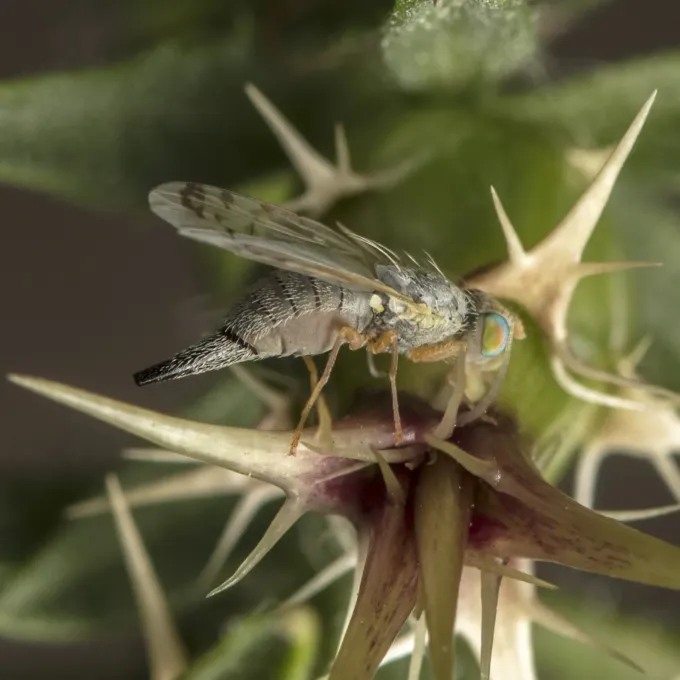
The thistle fruit fly (Acanthiophilus helianthi) belongs to the Tephritidae family, a group of dipterans known as fruit flies. Adult flies are characterized by their small size and distinct mottled wing patterns, which are vital for identification.
Measuring about 3–5 mm in length, the adult fly usually features a yellow to brown body. Its most prominent feature is the pattern of dark brown or black bands and spots on its transparent wings, forming a unique net-like appearance.
The larvae are typical of the family: cylindrical, legless, and creamy-white in color. They are adapted to live inside the flower heads of composite plants, where they consume seeds and floral tissues during their development.
The life cycle encompasses four stages: egg, larva, pupa, and adult. Hibernation occurs as a puparium, usually within the soil or inside dried plant remains, allowing the species to survive harsh winter temperatures.
This species is highly specialized in its habitat and host preference, being closely associated with plants of the Asteraceae family. Detecting adults on the developing buds of host plants is common during warm sunny days.
What it damages
The primary hosts for the thistle fruit fly are plants within the Asteraceae family. The pest causes significant economic losses in safflower (Carthamus tinctorius) cultivation by destroying the flower heads and the developing seeds.
Besides agricultural crops, the fly also infests wild relatives such as thistles (Cirsium and Carduus spp.), knapweeds, and sow thistles. These wild plants act as reservoirs, sustaining fly populations throughout the growing season.
Larvae bore into the flower head, feeding on the developing ovaries and seeds. This activity directly reduces the seed count and quality, leading to lower oil content in oilseed crops and decreased overall yield.
Feeding damage often compromises the integrity of the flower head, making it susceptible to secondary infections from fungi and bacteria. This can lead to the total rotting of the infested heads before they reach maturity.
In high-density infestations, the damage can lead to a drastic reduction in harvestable yield, making effective population management a priority for farmers growing susceptible Asteraceae species.
When it appears
Adult flies emerge from hibernation in the spring, triggered by rising temperatures. Their emergence coincides with the vegetative development and budding phases of their preferred host plants.
Females lay eggs into the floral structures of the buds. A single female can deposit dozens of eggs throughout her lifespan, often spreading them across multiple buds to maximize the offspring's survival chances.
Larval development takes place within the flower head, lasting several weeks. Given the favorable weather, the species can complete multiple generations in a single season, leading to an increasing pest pressure over time.
The peak of damage occurs in mid-summer when the larvae are actively feeding on the internal parts of the safflower heads. This timing is critical for implementing protective measures.
As autumn approaches, the insects prepare for diapause. They enter the pupal stage, seeking shelter in the soil or protected crevices of plant debris until the following spring.
Signs of infestation
Visible signs of infestation include the premature wilting or deformation of the flower heads. Often, the heads appear lopsided or stunted as the larvae destroy the developing seeds on one side.
Upon closer inspection, one can find entry or exit holes where the flies have interacted with the plant tissue. Inside the head, the accumulation of larval frass and destroyed seeds are clear indicators of presence.
Plants heavily infested often show early senescence, with petals drying up and falling off prematurely. The flower heads may also turn brown prematurely due to internal tissue necrosis.
Monitoring the adult fly population is possible through visual inspection of flowers in the morning or by using yellow sticky traps placed within the field. This helps in assessing the population density.
At the time of harvest, a high frequency of damaged heads and empty seeds indicates a severe infestation that may require adjustments in future crop protection strategies.
Control measures
Cultural practices are essential for managing this pest. Keeping fields and surrounding areas free of weeds like thistles and knapweeds is the most effective way to eliminate natural breeding grounds.
Deep plowing during the fall is an effective method to bury the pupae in the soil, preventing the adult flies from emerging in the following spring and reducing the starting infestation pressure.
Crop rotation should be implemented to break the pest cycle and discourage local population buildup. Spacing between safflower fields and wild infested sites also helps to minimize migration.
Chemical control is most effective when applied during the budding phase, before the larvae have penetrated deep into the flower head. Systemic insecticides are generally more effective in protecting the internal floral tissues.
Integrated Pest Management (IPM) requires regular monitoring of adult fly activity. If infestation levels exceed economic thresholds, timely application of targeted insecticides is necessary to preserve crop yield.
Taxonomy
- Latin name
- Acanthiophilus
- Order
- Diptera (flies)
- Family
- Tephritidae
- EPPO code
- ACAISP
Discussion
No discussions yet — be the first.