
Celery fly
Acidia
Description
How to identify
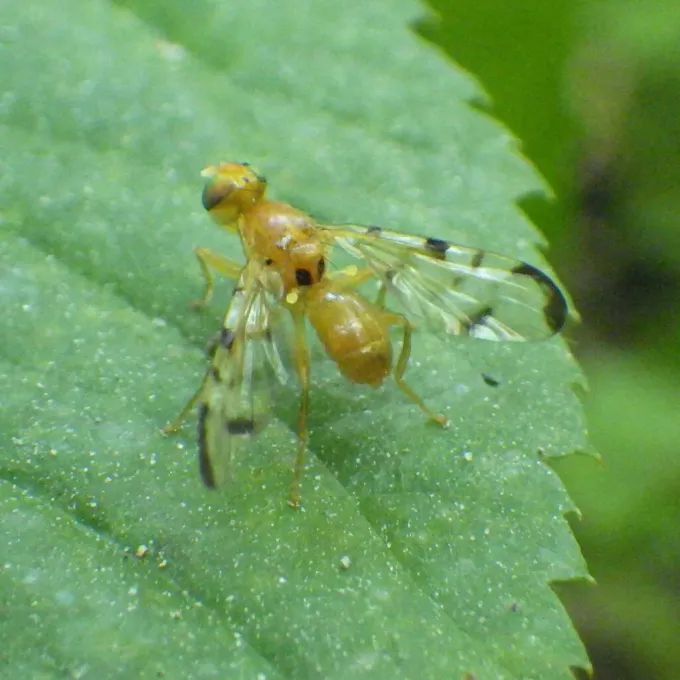
The celery fly (Euleia heraclei), often identified by the older synonym Acidia heraclei, belongs to the Tephritidae family of fruit flies. The adult fly is approximately 5–6 mm long with a yellowish-brown body and distinct, patterned, smoky-colored wings.
The larvae are legless and reach about 7 mm in length. Their color ranges from creamy white to yellowish, which makes them difficult to spot while they are feeding inside the leaf tissue.
Adults are diurnal insects. They are most active during warm, calm weather and often congregate in shaded or humid areas near their host plants to feed and mate.
The life cycle consists of the egg, larval, pupal, and adult stages. Depending on regional temperatures and seasonal moisture, the fly can produce two to three generations per year.
Overwintering occurs in the pupal stage. The puparia remain in the soil near the host plants, emerging as adults in late spring when the temperature begins to rise consistently.
What it damages
The primary hosts for the celery fly are members of the Apiaceae family. Celery (both stalk and root varieties), parsley, and parsnip are the most commonly attacked crops.
Wild species like hogweed or angelica often act as alternative hosts. When populations are high, these weeds can act as a bridge for the flies to infest commercial vegetable crops.
The damage is caused exclusively by the larvae. They burrow into the leaves, creating irregular, meandering channels known as "mines." This process destroys the internal leaf structure.
Severe infestations result in the loss of photosynthetic tissue, which significantly stunts plant growth. Affected plants often fail to produce quality roots or stalks, leading to a substantial reduction in yield.
If the infestation occurs early in the season, young seedlings may wither and die completely, making the crop unmarketable and difficult to recover without intervention.
When it appears
The first adult flies typically appear in May. The females seek out young, healthy leaves to lay their eggs, preferring the undersides of the foliage for protection.
Eggs hatch within approximately 7 to 10 days, depending on environmental temperature. The larvae then immediately bore into the leaf tissue, beginning their feeding process.
The population reaches its peak during the summer months, particularly in June and July. Consistent humidity and moderate heat favor rapid reproduction and frequent generations.
One generation lasts roughly one month. In hot, dry climates, the development might slow down, but irrigated gardens remain susceptible throughout the entire summer season.
By late autumn, the final generation of larvae pupates in the soil. These pupae enter a state of diapause, waiting for the spring warmth to restart the cycle.
Signs of infestation
The most visible sign of celery fly activity is the appearance of light-colored, blistered patches on the leaves. These patches eventually turn brown and become dry and papery.
Inspecting the leaves against the light will often reveal the larvae moving within the mines. These areas are distinct from fungal spots because of their complex, channel-like structure.
Leaves affected by heavy mining may become misshapen, curl up, or fall off prematurely. This damage prevents the plant from storing energy in the roots or developing healthy stalks.
Early warning signs include tiny puncture marks on the leaves, created by the female fly when she inserts her eggs into the plant tissue.
Unlike wilting caused by root rot, celery fly damage is localized to the leaves. However, severe foliage loss will eventually impact the entire plant's health and vitality.
Control measures
Crop rotation is essential for managing this pest. Avoid planting celery or related crops in the same area for at least three years, as pupae can remain in the soil.
Using horticultural fleece or fine netting is highly effective at preventing the adult flies from reaching the plants to lay their eggs during the vulnerable seedling stage.
Regular soil cultivation during the season helps expose and destroy pupae residing in the upper layers of the soil, effectively reducing the population for the next season.
For home gardeners, hand-picking and destroying infested leaves is a simple and effective way to remove larvae before they emerge to pupate and increase the population.
Biological control can be enhanced by encouraging natural predators, such as parasitic wasps, which prey on the larvae. In some cases, systemic insecticides may be used, provided safety intervals are strictly followed.
Taxonomy
- Latin name
- Acidia
- Order
- Diptera (flies)
- Family
- Tephritidae
- EPPO code
- ACIDSP
Discussion
No discussions yet — be the first.