

SKU #73229
·
66 views
ZAVOLZHSKIY
Sweet Clover
User rating
0 votes0% positive reviews
No ratings yet — be the first.
Type
White yarrow
Vegetation Period
80–120
Plant Height
150–200
Usage
Hay Bales, Green Mass
Prices in stores
from215.43 €per 1 kg
pack from 0.82 € per 1 g
3 offers from 1 store
Store offers · 3 from 1 stores
Prices are updated on loadLoading offers…
Available at: Semena-online
Aggregator catalog: prices are collected automatically from store websites, normalized by AI and converted at the current exchange rate. Before ordering, confirm the price and availability on the store's website. This block is not indexed by search engines — the data is loaded after the page opens.
About product

ZAVOLZHSKIY is a variety of white sweetclover (Melilotus albus Medik.), grown in various regions of Russia, including the Volga Region and the Chernozem region. The plant is characterized by an average height of 140–180 cm, weak bushiness, and erect stems without pubescence. The leaves are trifoliate, dark green, without a waxy bloom, and the inflorescences have a racemose form.The variety is dist…
Type
White yarrow
Vegetation Period
80–120
Plant Height
150–200
Usage
Hay Bales, Green Mass
Description
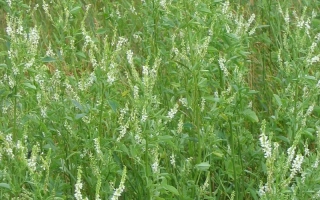
ZAVOLZHSKIY is a variety of white sweetclover (Melilotus albus Medik.), grown in various regions of Russia, including the Volga Region and the Chernozem region. The plant is characterized by an average height of 140–180 cm, weak bushiness, and erect stems without pubescence. The leaves are trifoliate, dark green, without a waxy bloom, and the inflorescences have a racemose form.
The variety is distinguished by good drought resistance and the ability to grow on light sandy, chernozem, calcareous, and saline soils. The vegetation period is 100–120 days; flowering and fruiting occur in June–September. White sweetclover of the Volga Region is an excellent nectar plant and is widely used for grazing animals, as well as as raw material for the production of silage, silage, and dehydrated feeds.
Green mass yield ranges from 25 to 37 tons per hectare, while dry matter yield reaches 7.1 t/ha. Crude protein content at the flowering stage is from 16.7% to 18.1%. The seeds of the variety have a yellow color, oval shape, and a length of about 2.5 mm; their weight of 1000 pods is approximately 3 grams, and seed hardness is in the range of 4–5%. Due to the high nutritional properties, white sweetclover of the Volga Region ensures high-quality silage when mixed with cereals and is a valuable source of minerals for animals.
The variety is distinguished by good drought resistance and the ability to grow on light sandy, chernozem, calcareous, and saline soils. The vegetation period is 100–120 days; flowering and fruiting occur in June–September. White sweetclover of the Volga Region is an excellent nectar plant and is widely used for grazing animals, as well as as raw material for the production of silage, silage, and dehydrated feeds.
Green mass yield ranges from 25 to 37 tons per hectare, while dry matter yield reaches 7.1 t/ha. Crude protein content at the flowering stage is from 16.7% to 18.1%. The seeds of the variety have a yellow color, oval shape, and a length of about 2.5 mm; their weight of 1000 pods is approximately 3 grams, and seed hardness is in the range of 4–5%. Due to the high nutritional properties, white sweetclover of the Volga Region ensures high-quality silage when mixed with cereals and is a valuable source of minerals for animals.
Crop & resistance
Crop
Specifications hover over for a hint about the specification
|
Type
Type
Galia (Galia) type — relatively new, of Israeli origin, although there are indications that this variety may originate from Spain. The fruits of this type are round or oval, weighing about 1 kg. The surface is smooth, covered with a delicate, connected netting, turning yellow whe... |
|
|---|---|
| Vegetation Period | 80–120 |
| Plant Height | 150–200 |
| Usage | |
| Registration year | 2019 |
| Catalog | Catalog → Sweet Clover |
| Legal data |
Show · 11
|
| Country | Russia |
Not yet комментариев. Be the first!
Alternatives
Sweet Clover · similar varieties




See also
Often considered together with this variety





Recently viewed
Products you’ve viewed on this site
Reviews · 0