


SKU #73237
·
52 views
DONCHE
Sweet Clover
User rating
0 votes0% positive reviews
No ratings yet — be the first.
Type
Yellow Yarrow
Plant Height
80–150
Registration year
2015
About product

Yellow Sweetclover (Melilotus officinalis Lam.) is a semi-erect shrub that reaches a height of 105–125 cm in the flowering stage and 180–190 cm at seed maturity. The stem is straight and hairless, with high branching that ensures good air circulation and plant stability. Leaves are alternate, trifoliate: lower leaflets are narrowly oval on short petioles, while upper ones are oval on long petioles…
Type
Yellow Yarrow
Plant Height
80–150
Registration year
2015
Description
Yellow Sweetclover (Melilotus officinalis Lam.) is a semi-erect shrub that reaches a height of 105–125 cm in the flowering stage and 180–190 cm at seed maturity. The stem is straight and hairless, with high branching that ensures good air circulation and plant stability. Leaves are alternate, trifoliate: lower leaflets are narrowly oval on short petioles, while upper ones are oval on long petioles. Each leaf has two entire awl-shaped stipules with serrated blunt-toothed margins.
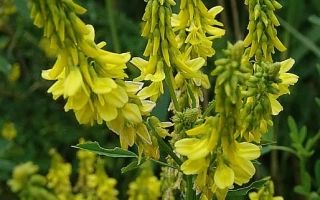
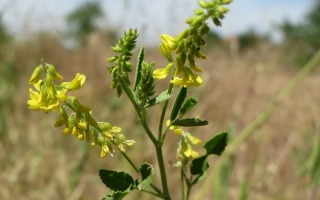
The variety is characterized by bright yellow flowers gathered into a raceme inflorescence 13–15 cm long. The flowers droop and bloom on a short pedicel, creating an attractive appearance and increasing attractiveness to pollinating insects. The fruit is a single-seeded oval asymmetrical pod 5.1–6.2 mm long and 2.2–3.1 mm wide, brownish-brown in color with transverse wrinkles. Seeds are oval in shape, smooth, greenish-yellow (immature with brown spots), with a mass of 1000 seeds ranging from 2.7–2.9 g.
The vegetative period from full spring growth to flowering is 55–58 days, and to seed maturity is 105–110 days. The yield of green mass averages 290–310 c/ha over two years of pasture use, hay is 70–80 c/ha, and seeds is 18–20 c/ha. These figures make yellow sweetclover valuable both for producing fodder crops and for collecting seeds as biological fertilizers.
The variety is characterized by bright yellow flowers gathered into a raceme inflorescence 13–15 cm long. The flowers droop and bloom on a short pedicel, creating an attractive appearance and increasing attractiveness to pollinating insects. The fruit is a single-seeded oval asymmetrical pod 5.1–6.2 mm long and 2.2–3.1 mm wide, brownish-brown in color with transverse wrinkles. Seeds are oval in shape, smooth, greenish-yellow (immature with brown spots), with a mass of 1000 seeds ranging from 2.7–2.9 g.
The vegetative period from full spring growth to flowering is 55–58 days, and to seed maturity is 105–110 days. The yield of green mass averages 290–310 c/ha over two years of pasture use, hay is 70–80 c/ha, and seeds is 18–20 c/ha. These figures make yellow sweetclover valuable both for producing fodder crops and for collecting seeds as biological fertilizers.
Crop & resistance
Crop
Specifications hover over for a hint about the specification
Store offers
Prices are updated on loadLoading offers…
Aggregator catalog: prices are collected automatically from store websites, normalized by AI and converted at the current exchange rate. Before ordering, confirm the price and availability on the store's website. This block is not indexed by search engines — the data is loaded after the page opens.
Not yet комментариев. Be the first!
Alternatives
Sweet Clover · similar varieties



See also
Often considered together with this variety




Recently viewed
Products you’ve viewed on this site
Reviews · 0