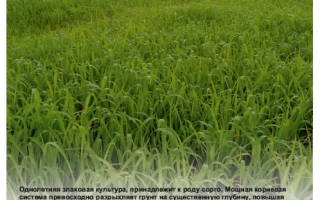
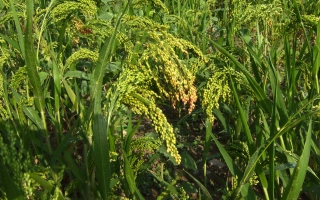
KULUNDINSKAYA – a variety of sudangrass (Sorghum xdrummondii), mid-early maturing and intended for green fodder and high-quality hay production. Plants reach a height of 171–207 cm, have an upright bush with weak bushiness, a medium-thick stem, and juiciness. Leaves are linear, 40–60 cm long and 2.5–4.0 cm wide, while panicles are oblong-elliptic with awned scales of black-brown color. Seeds are oval-elliptic and yellowish-brown.
The grass is characterized by good drought resistance and resistance to lodging, as well as an accelerated initial growth rate and regrowth after cutting. As a result, up to five cuts can be made in one season, yielding more than 1000 centners of grass per hectare. When processed into silage or hay, it retains a high level of nutrients: approximately 12.33% crude protein, 46.30% biologically available energy (BEE), and 29.55% fiber.
KULUNDINSKAYA is easily grazed by large livestock – cows, horses, sheep, and other cattle – due to its soft taste and pleasant aroma. In its green form, it is rich in sugar, proteins, ash, vitamins, and minerals, making it a valuable feed for maintaining animal health and productivity. With proper cutting and storage in silage or hay, dry matter yield is about 51.3 c/ha, and seed quantity is approximately 11.6 c/ha.