


SKU #71840
·
67 views
Sudan grass AIDA
Sudan Grass
User rating
0 votes0% positive reviews
No ratings yet — be the first.
Vegetation Period
65–75
Plant Height
150–250
Green Mass Yield (t/ha)
35–45
Hay Yield (t/ha)
6–8
Prices in stores
from1.66 €per 1 kg
pack from 1.95 € per 1 kg
2 offers from 1 store
Store offers · 2 from 1 stores
Prices are updated on loadLoading offers…
Available at: AgroSemka
Aggregator catalog: prices are collected automatically from store websites, normalized by AI and converted at the current exchange rate. Before ordering, confirm the price and availability on the store's website. This block is not indexed by search engines — the data is loaded after the page opens.
About product

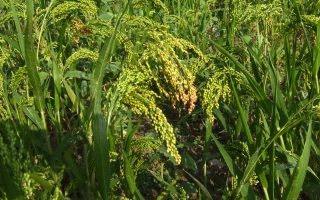
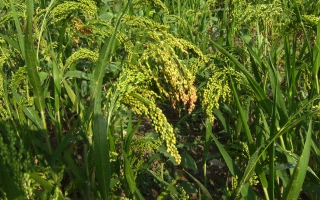
Sudan grass (Sorghum x drummondii), known as Aida, is an annual grass plant up to 250 cm tall with a well-developed root system that provides deep penetration and drought resistance. Due to its high productivity, two to four cuts can be obtained per season: the first cut is made 65-70 days after sowing, the second 40-45 days later, and the third 30 days later. The recommended cutting height is 6-8…
Vegetation Period
65–75
Plant Height
150–250
Green Mass Yield (t/ha)
35–45
Hay Yield (t/ha)
6–8
Description
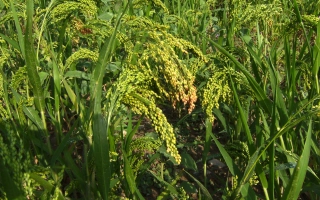
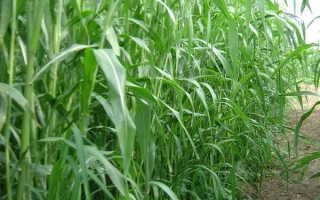
Sudan grass (Sorghum x drummondii), known as Aida, is an annual grass plant up to 250 cm tall with a well-developed root system that provides deep penetration and drought resistance. Due to its high productivity, two to four cuts can be obtained per season: the first cut is made 65-70 days after sowing, the second 40-45 days later, and the third 30 days later. The recommended cutting height is 6-8 cm, and the optimal soil temperature for sowing is 9-11 °C.
The feed value of Sudan grass is high: in green mass, protein content reaches 11%, and carbohydrates are about 70%. In hay, it maintains a significant level of protein (up to 12%) and provides livestock with a rich set of vitamins A, B1, B2, B6, carotene, and microelements Fe, Mg, Zn, Mn, K. When comparing energy value with young corn silage, 100 kg of Aida gives approximately 17 ME, while 1 ton of hay provides about 52 ME.
Yield depends on growing conditions: in pure fields with proper fertilization and irrigation, up to 40 tons/ha of green mass, 5-9 tons/ha of hay, and 300 kg/ha of seeds can be achieved. In the Lower Volga region, hay yield is about 49 centners/ha, and in other regions, from 10 to 22.5 tons/ha. Sudan grass responds well to irrigation, remains drought and cold-resistant, making it attractive for a wide range of climate zones, including the North Caucasus, Volga, and Central Black Earth region.
Thus, Aida is a highly productive, nutritious feed crop with excellent properties for protein and energy retention in hay, capable of providing livestock with complete nutrition even under adverse climatic conditions.
The feed value of Sudan grass is high: in green mass, protein content reaches 11%, and carbohydrates are about 70%. In hay, it maintains a significant level of protein (up to 12%) and provides livestock with a rich set of vitamins A, B1, B2, B6, carotene, and microelements Fe, Mg, Zn, Mn, K. When comparing energy value with young corn silage, 100 kg of Aida gives approximately 17 ME, while 1 ton of hay provides about 52 ME.
Yield depends on growing conditions: in pure fields with proper fertilization and irrigation, up to 40 tons/ha of green mass, 5-9 tons/ha of hay, and 300 kg/ha of seeds can be achieved. In the Lower Volga region, hay yield is about 49 centners/ha, and in other regions, from 10 to 22.5 tons/ha. Sudan grass responds well to irrigation, remains drought and cold-resistant, making it attractive for a wide range of climate zones, including the North Caucasus, Volga, and Central Black Earth region.
Thus, Aida is a highly productive, nutritious feed crop with excellent properties for protein and energy retention in hay, capable of providing livestock with complete nutrition even under adverse climatic conditions.
Crop & resistance
Crop
Specifications
| Vegetation Period | 65–75 |
|---|---|
| Plant Height | 150–250 |
| Green Mass Yield (t/ha) | 35–45 |
| Hay Yield (t/ha) | 6–8 |
| Number of cuts per season | 2, 3, 4 |
| Protein content in dry matter (%) | 10–12 |
| Usage | |
| Registration year | 2003 |
| Catalog | Catalog → Sudan Grass |
| Legal data |
Show · 1
|
| Country | Russia |
Not yet комментариев. Be the first!
Alternatives
Sudan Grass · similar varieties






See also
Often considered together with this variety




Recently viewed
Products you’ve viewed on this site
Reviews · 0