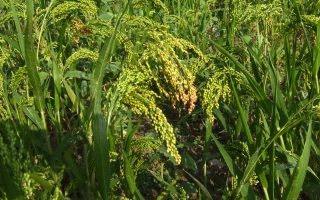
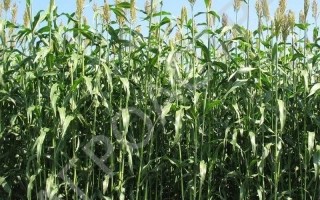
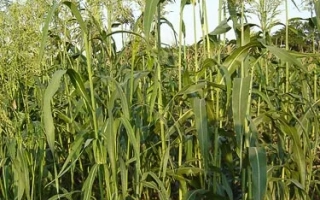
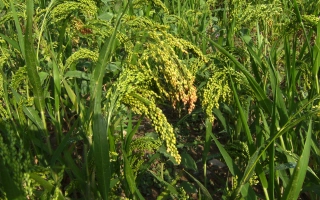
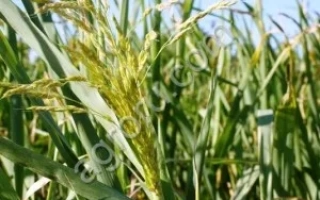
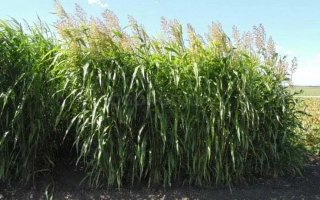
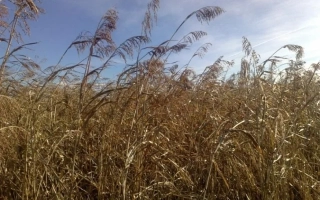
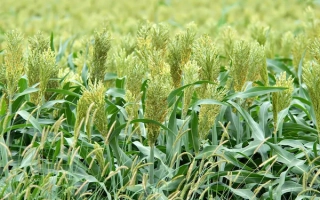
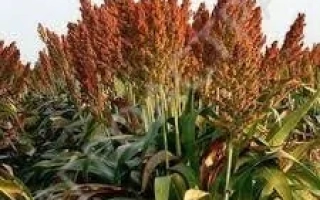
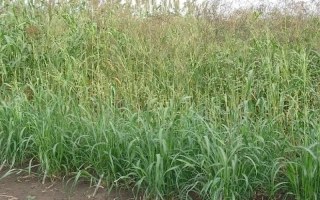
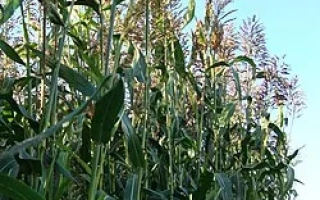
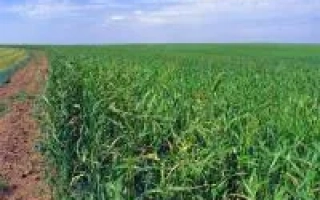
Sudan grass "EUGENIA" is an annual forage crop characterized by early maturity and high productivity. The plant forms a herbaceous bush up to 3 m tall with semi-erect medium-length stems and numerous medium-sized narrow leaves. The leaves have a greenish vein, and the panicle is drooping, wider at the lower part. The seeds are ellipsoidal in shape and light brown in color.
The forage value of "EUGENIA" exceeds many other grasses: proteins constitute more than 10%, carbohydrates – 68%, and protein content exceeds 5%. The composition also includes carotene, sugars, fiber, and a wide range of macro- and microelements (copper, iron, zinc, magnesium, manganese, molybdenum, selenium, potassium, calcium, phosphorus). Thanks to its rich vitamin composition (PP, A, B1, B2, B5, B6, H), the grass provides balanced nutrition for livestock.
"EUGENIA" is distinguished by good drought and salt resistance, and does not require specific soil types – suitable for most soils, except for marshy and heavily saline areas. The plant recovers quickly after mowing: intensive growth begins 1.5 months after sowing, adding 5–10 cm daily. This allows for several cuts during the season (usually two to three, up to five with irrigation). For silage production, the grass is mowed at the milk ripeness phase of the grain.
The "EUGENIA" variety is widely used as a forage crop and green manure. In mixed sowings with annual grain legumes (soybean, vetch, pea, lupin), it improves soil structure, enhancing its aeration, water-holding capacity, and drainage properties. Due to its high productivity and nutritional value, "EUGENIA" is the preferred choice for farmers seeking to improve animal feeding efficiency and agroecosystem resilience.