


SKU #74437
·
48 views
Starry
Lupin
User rating
0 votes0% positive reviews
No ratings yet — be the first.
Plant Height
150–250
Usage
On green feed, Hay Bales, Silage
Registration year
2005
About product

High-yield forage lupin variety featuring excellent disease resistance and consistent biomass production for silage and hay.
Plant Height
150–250
Usage
On green feed, Hay Bales, Silage
Registration year
2005
Description
Field Performance of the Zirkovyi Lupin Variety
When selecting a forage crop, reliability and ease of management are just as important as yield potential. Developed by the National Scientific Center 'Institute of Agriculture of NAAS', the Zirkovyi variety is engineered for high-volume biomass production while maintaining robust field health.
Agronomic Management
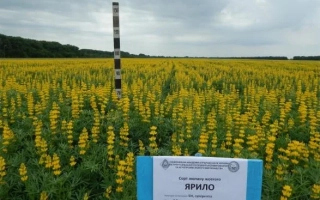
With a plant height of 150–250 cm, Zirkovyi establishes a dense canopy. This vigorous growth habit is an operational advantage, as it effectively outcompetes weeds, reducing the frequency of herbicide applications and overall field labor. For the farm operator, this means less time spent on weed control and lower input costs per hectare.
Disease Resistance and Efficiency
Disease management is often the most significant overhead in legume production. Zirkovyi stands out due to its inherent resistance to anthracnose, brown spot, and fusarium. In practical terms, this allows for a streamlined spray program, as the variety maintains health under standard conditions without requiring excessive fungicidal interventions. This stability ensures that the projected biomass yield is protected throughout the growing season, minimizing the risk of crop loss due to common pathogens.
Forage Utilization
Versatility is at the core of the Zirkovyi variety's value proposition. It is well-adapted to Ukrainian soil conditions and offers flexible harvesting options for various livestock systems:
- Green Feed: Ideal for direct grazing or green-chop feeding.
- Silage: Delivers consistent quality for silage production.
- Hay: Dries reliably for high-quality winter forage.
Crop & resistance
Crop
Disease resistance
Specifications
| Plant Height | 150–250 |
|---|---|
| Usage | |
| Registration year | 2005 |
| Catalog | Catalog → Lupin |
| Legal data |
Show · 1
|
| Country | Ukraine |
Store offers
Prices are updated on loadLoading offers…
Aggregator catalog: prices are collected automatically from store websites, normalized by AI and converted at the current exchange rate. Before ordering, confirm the price and availability on the store's website. This block is not indexed by search engines — the data is loaded after the page opens.
Not yet комментариев. Be the first!




See also
Often considered together with this variety






Recently viewed
Products you’ve viewed on this site
Reviews · 0