


SKU #74452
·
50 views
Horizont
Lupin
User rating
0 votes0% positive reviews
No ratings yet — be the first.
Green Mass Yield (t/ha)
45–55
Registration year
2002
About product

A high-yielding lupin variety for premium protein forage and sustainable soil regeneration.
Green Mass Yield (t/ha)
45–55
Registration year
2002
Description
Optimizing Feed Production and Soil Health
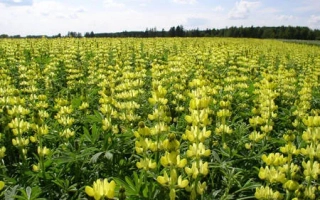
The 'Horizont' lupin variety is a strategic asset for agricultural enterprises focused on high-protein fodder production and sustainable soil management. Developed by the National Scientific Center 'Institute of Agriculture of NAAS', this variety is designed to deliver consistent performance, yielding 45–55 tons of green mass per hectare.
Practical Applications for Modern Farming
- Silage and Haylage Production. Given its high biomass output, Horizont provides a reliable source of protein for livestock rations, helping farmers reduce dependence on expensive concentrated feed additives.
- Soil Structure and Nitrogen Fixation. Beyond its feed value, Horizont acts as an excellent green manure. Its deep root system improves soil aeration and porosity, while its nitrogen-fixing capabilities naturally rejuvenate the field for subsequent crops.
- Disease Resilience. One of the primary advantages of this variety is its natural resistance to fusarium. This trait provides a significant safety buffer, protecting yields in challenging weather conditions and reducing the need for intensive fungicide applications.
Integrating 'Horizont' into a standard crop rotation is straightforward. It is highly compatible with conventional harvesting machinery and does not require specialized management protocols. By prioritizing this variety, farms gain a robust, predictable, and cost-effective crop that bridges the gap between high-yield feed requirements and long-term land productivity.
Crop & resistance
Crop
Disease resistance
Specifications
| Green Mass Yield (t/ha) | 45–55 |
|---|---|
| Registration year | 2002 |
| Catalog | Catalog → Lupin |
| Legal data |
Show · 1
|
| Country | Ukraine |
Store offers
Prices are updated on loadLoading offers…
Aggregator catalog: prices are collected automatically from store websites, normalized by AI and converted at the current exchange rate. Before ordering, confirm the price and availability on the store's website. This block is not indexed by search engines — the data is loaded after the page opens.
Not yet комментариев. Be the first!







See also
Often considered together with this variety




Recently viewed
Products you’ve viewed on this site
Reviews · 0