
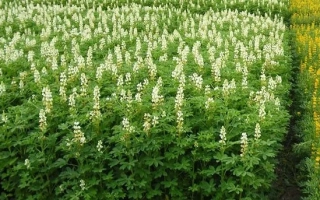

SKU #74419
·
47 views
Borke
Lupin
User rating
0 votes0% positive reviews
No ratings yet — be the first.
Usage
Cover Crop
Plant Height
25-30
Protein content in dry matter (%)
50
Registration year
2000
About product

High-protein green manure crop designed for rapid soil regeneration and effective weed suppression.
Usage
Cover Crop
Plant Height
25-30
Protein content in dry matter (%)
50
Registration year
2000
Description
Technical Overview of the Lupin Variety «Borky»
The «Borky» lupin is a specialized variety developed by the National Scientific Center «Institute of Agriculture of NAAS». It is designed primarily for green manure application, serving as a high-performance tool for soil conditioning and nitrogen enrichment in agricultural systems.
Key Technical Specifications
- Type: Green manure (siderate) cultivar.
- Plant height: 25–30 cm.
- Protein content in dry matter: 50%.
The structural efficiency of «Borky» stems from its compact growth habit. Reaching 25–30 cm in height, the plant develops a dense canopy that suppresses weed emergence through shading. For practical farm management, this low-profile height is a significant advantage: it facilitates uniform incorporation into the soil during plowing or disking, preventing excessive residue interference with subsequent sowing equipment.
The high protein concentration of 50% in the dry matter is the defining performance metric of this variety. It ensures that when incorporated into the soil, the biomass acts as a high-quality organic fertilizer, rapidly releasing nitrogen and stimulating microbial activity. This translates into faster decomposition rates compared to lower-protein green manures, allowing for shorter intervals between cover crop termination and cash crop planting.
By utilizing «Borky» in a crop rotation, producers can effectively reduce their reliance on synthetic nitrogen inputs. Its ability to fix atmospheric nitrogen and improve soil structure makes it an essential component for sustainable and precision farming operations that aim to maintain long-term soil fertility and organic matter levels.
Crop & resistance
Crop
Specifications
| Usage | |
|---|---|
| Plant Height | 25-30 |
| Protein content in dry matter (%) | 50 |
| Registration year | 2000 |
| Catalog | Catalog → Lupin |
| Legal data |
Show · 1
|
| Country | Ukraine |
Store offers
Prices are updated on loadLoading offers…
Aggregator catalog: prices are collected automatically from store websites, normalized by AI and converted at the current exchange rate. Before ordering, confirm the price and availability on the store's website. This block is not indexed by search engines — the data is loaded after the page opens.
Not yet комментариев. Be the first!



See also
Often considered together with this variety





Recently viewed
Products you’ve viewed on this site
Reviews · 0