
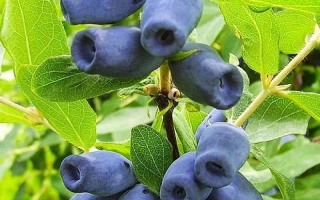


SKU #70144
·
58 views
SLASTENA
Honeysuckle
User rating
0 votes0% positive reviews
No ratings yet — be the first.
Berry Weight
1.0–1.5
Flavor
Sour-sweet
Sugar Content
11–13
Yield (kg per plant)
4.0–5.0
Store offers · 1 from 1 stores
Prices are updated on loadLoading offers…
Available at: Agromir
Aggregator catalog: prices are collected automatically from store websites, normalized by AI and converted at the current exchange rate. Before ordering, confirm the price and availability on the store's website. This block is not indexed by search engines — the data is loaded after the page opens.
About product

The shrub of the 'Slastena' honeysuckle grows slowly, featuring a compact, rounded crown, dense branches with brown-red bark, and small oval leaves covered with a fine fuzz. Pale pink flowers appear in May-June, followed by large oval fruits in a blue-violet hue. These berries have thick skin, a waxy coating, and weigh up to 1.5 g. The taste is sweet and sour, with a delicate and refreshing aroma;…
Berry Weight
1.0–1.5
Flavor
Sour-sweet
Sugar Content
11–13
Yield (kg per plant)
4.0–5.0
Description
The shrub of the 'Slastena' honeysuckle grows slowly, featuring a compact, rounded crown, dense branches with brown-red bark, and small oval leaves covered with a fine fuzz. Pale pink flowers appear in May-June, followed by large oval fruits in a blue-violet hue. These berries have thick skin, a waxy coating, and weigh up to 1.5 g. The taste is sweet and sour, with a delicate and refreshing aroma; sugar content is about 13%, and acidity is 1.8%.
The shrub begins fruiting in the second year after planting and can yield more than 4 kg per shrub with proper care. 'Slastena' is self-sterile, so for maximum yield, it is typically planted alongside pollinator varieties such as Amfora, Nimfa, or Fialka. The plant is hardy to frost down to -45 °C and tolerates drought well, though yield and berry quality decrease during severe dry periods.
Fruits can be eaten fresh or used for jams, compotes, and baking. To protect against fungal diseases, wood ash, colloidal sulfur, calcined soda, or copper-soap solution are applied; for aphid and mealybug infestations, use 'Actellik' or 'Rogor'. Thanks to its high yield, hardiness, and pest resistance, 'Slastena' is suitable for cultivation in any region of Russia.
The shrub begins fruiting in the second year after planting and can yield more than 4 kg per shrub with proper care. 'Slastena' is self-sterile, so for maximum yield, it is typically planted alongside pollinator varieties such as Amfora, Nimfa, or Fialka. The plant is hardy to frost down to -45 °C and tolerates drought well, though yield and berry quality decrease during severe dry periods.
Fruits can be eaten fresh or used for jams, compotes, and baking. To protect against fungal diseases, wood ash, colloidal sulfur, calcined soda, or copper-soap solution are applied; for aphid and mealybug infestations, use 'Actellik' or 'Rogor'. Thanks to its high yield, hardiness, and pest resistance, 'Slastena' is suitable for cultivation in any region of Russia.
Video · 5 videos
Suggest a video →Crop & resistance
Crop
Specifications
| Berry Weight | 1.0–1.5 |
|---|---|
| Flavor | |
| Sugar Content | 11–13 |
| Yield (kg per plant) | 4.0–5.0 |
| Frost Resistance | |
| Assignment | |
| Registration year | 2013 |
| Catalog | Catalog → Honeysuckle |
| Legal data | |
| Country | Russia |
Not yet комментариев. Be the first!
Alternatives
Honeysuckle saplings · similar varieties


See also
Often considered together with this variety






Recently viewed
Products you’ve viewed on this site
Reviews · 0