


SKU #70145
·
71 views
BARBALETA
Honeysuckle
User rating
0 votes0% positive reviews
No ratings yet — be the first.
Berry Weight
1.0–1.5
Flavor
Sour-sweet
Bush height, cm
1.0–1.2
Assignment
For Fresh Consumption
About product

BARBALETA is a mid-early cultivar of honeysuckle (Lonicera caerulea L.) characterized by compact growth and medium bush density, reaching up to 1.1 m in height. The bushes have an inverse-conical shape, with thick, straight, reddish-brown, and pubescent canes. Leaves are of medium size, green in color, elongated-ovate in shape with a convex lamina and semi-oval stipules.The cultivar's berries are…
Berry Weight
1.0–1.5
Flavor
Sour-sweet
Bush height, cm
1.0–1.2
Assignment
For Fresh Consumption
Description
BARBALETA is a mid-early cultivar of honeysuckle (Lonicera caerulea L.) characterized by compact growth and medium bush density, reaching up to 1.1 m in height. The bushes have an inverse-conical shape, with thick, straight, reddish-brown, and pubescent canes. Leaves are of medium size, green in color, elongated-ovate in shape with a convex lamina and semi-oval stipules.
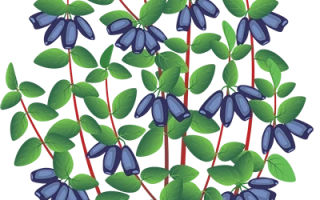
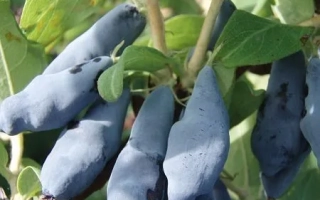
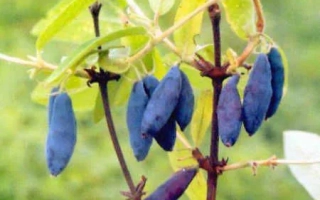
The cultivar's berries are large, flask-shaped, with slightly rounded tops and bases. Their color is blue-gray with a strong waxy bloom; the skin is of medium density, while the pulp is juicy, sweet, and without bitterness. The average berry weight is about 1.1 grams, making them convenient for fresh consumption or in the preparation of desserts. The taste combines sour-sweet notes with a bright aroma.
The cultivar is resistant to temperature fluctuations in the winter period and is not damaged by spring return frosts, and also shows resistance to aphid infestation. Berries ripen in the third decade of June, after flowering begins in the beginning of the second decade of May. Thanks to self-incompatibility, yield increases in the presence of a nearby pollinator. The berries contain a rich complex of biologically active substances: vitamin C, carotene, thiamine, riboflavin, folic acid, and trace elements, which makes them beneficial for health.
The cultivar's berries are large, flask-shaped, with slightly rounded tops and bases. Their color is blue-gray with a strong waxy bloom; the skin is of medium density, while the pulp is juicy, sweet, and without bitterness. The average berry weight is about 1.1 grams, making them convenient for fresh consumption or in the preparation of desserts. The taste combines sour-sweet notes with a bright aroma.
The cultivar is resistant to temperature fluctuations in the winter period and is not damaged by spring return frosts, and also shows resistance to aphid infestation. Berries ripen in the third decade of June, after flowering begins in the beginning of the second decade of May. Thanks to self-incompatibility, yield increases in the presence of a nearby pollinator. The berries contain a rich complex of biologically active substances: vitamin C, carotene, thiamine, riboflavin, folic acid, and trace elements, which makes them beneficial for health.
Video · 1 video
Suggest a video →Crop & resistance
Crop
Pest resistance
Specifications
| Berry Weight | 1.0–1.5 |
|---|---|
| Flavor | |
| Bush height, cm | 1.0–1.2 |
| Assignment | |
| Registration year | 2006 |
| Catalog | Catalog → Honeysuckle |
| Legal data | |
| Country | Russia |
Store offers
Prices are updated on loadLoading offers…
Aggregator catalog: prices are collected automatically from store websites, normalized by AI and converted at the current exchange rate. Before ordering, confirm the price and availability on the store's website. This block is not indexed by search engines — the data is loaded after the page opens.
Not yet комментариев. Be the first!
Alternatives
Honeysuckle saplings · similar varieties





See also
Often considered together with this variety




Recently viewed
Products you’ve viewed on this site
Reviews · 0