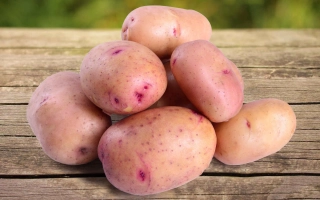
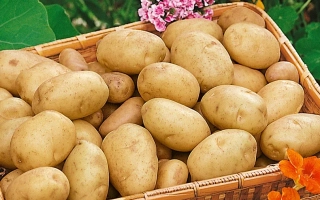
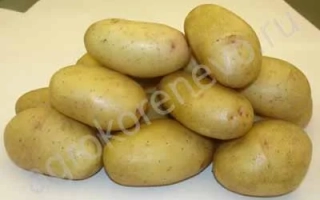
Arrow potato variety — an early-maturing table variety developed in the Netherlands with a vegetation period of 60-70 days. The plant is low to medium height, intermediate type, with a spreading bush form. Leaves are medium to large size, green color with slight leaf edge waviness, white medium to large flower. Tubers are oval with small eyes, yellow skin, creamy flesh. Marketable tuber mass ranges from 80-120 grams, with tuber numbers per plant varying from 7 to 11. Starch content is within the range of 12-16.4%, making this variety suitable for various cooking methods. Arrow variety is characterized by high yield — from 227 to 295 centners per hectare, with maximum yields up to 350 centners per hectare. First harvest can be taken as early as 45 days after emergence, with yield reaching 191-230 centners per hectare. Second harvest on day 55 yields 246-282 centners per hectare, significantly exceeding standard varieties. Tubers have 90-97% marketability and 94% storability, ensuring good storage and product quality retention. Arrow potato is resistant to potato cancer pathogen and golden potato cyst nematode, and has moderate resistance to late blight. The variety is susceptible to phytophthora on foliage, but tubers show resistance to this disease. It is not resistant to fusarium and striped mosaic. For successful cultivation, seed tubers should be pre-sprouted and planted in well-heated soil, with split application of nitrogen fertilizers. The flesh does not darken when boiled and retains cut shape, making it suitable for making soups, frying, baking, and as young potatoes.