

SKU #62225
·
55 views
RUSSMOL
Grape
FRSCUser rating
0 votes0% positive reviews
No ratings yet — be the first.
Ripening Period
Medium, Mid-late
Cold Resistance
High (up to -24°C)
Resistance to Mildew
High
Resistance to oidium
High
About product

Russmol — a medium or medium-late ripening grape variety, characterized by high resistance to diseases such as mildew and powdery mildew, as well as tolerance to phylloxera. Bushes are vigorous, with good rooting of cuttings and high frost resistance up to -23...-24°C. The period from budburst to full berry ripening is 130-150 days, which allows the variety to be used in various climatic condition…
Ripening Period
Medium, Mid-late
Cold Resistance
High (up to -24°C)
Resistance to Mildew
High
Resistance to oidium
High
Description
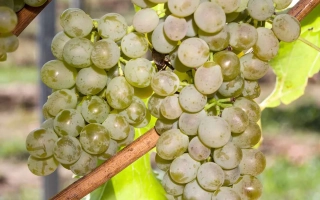
Russmol — a medium or medium-late ripening grape variety, characterized by high resistance to diseases such as mildew and powdery mildew, as well as tolerance to phylloxera. Bushes are vigorous, with good rooting of cuttings and high frost resistance up to -23...-24°C. The period from budburst to full berry ripening is 130-150 days, which allows the variety to be used in various climatic conditions.
Clusters of Russmol are large, conical in shape, weighing from 500 to 750 grams, moderately dense or dense. Berries are oval, white, large and very large — 32x24 mm in size and 7-10 grams in weight. The taste is pleasant and harmonious, sometimes with a slight muscat note. Sugar content of the berries is 16-18%, acidity — 7-9 g/l, which makes the grape suitable for fresh consumption and processing.
The variety is distinguished by good yield and a high percentage of fruiting shoots (65-85%), with a fruitfulness coefficient of 1.3-1.7. Recommended load per bush is 30-40 buds, with pruning of vines to 6-8 buds or short pruning to 2-4 buds. Russmol responds positively to a high level of agrotechnology. Under conditions of wet weather during ripening, berry cracking is possible, which can be partially prevented by thinning young berries after flowering, which also contributes to increasing their size. The variety is compatible with most rootstocks and is widely used in agriculture.
Clusters of Russmol are large, conical in shape, weighing from 500 to 750 grams, moderately dense or dense. Berries are oval, white, large and very large — 32x24 mm in size and 7-10 grams in weight. The taste is pleasant and harmonious, sometimes with a slight muscat note. Sugar content of the berries is 16-18%, acidity — 7-9 g/l, which makes the grape suitable for fresh consumption and processing.
The variety is distinguished by good yield and a high percentage of fruiting shoots (65-85%), with a fruitfulness coefficient of 1.3-1.7. Recommended load per bush is 30-40 buds, with pruning of vines to 6-8 buds or short pruning to 2-4 buds. Russmol responds positively to a high level of agrotechnology. Under conditions of wet weather during ripening, berry cracking is possible, which can be partially prevented by thinning young berries after flowering, which also contributes to increasing their size. The variety is compatible with most rootstocks and is widely used in agriculture.
Crop & resistance
Crop
Disease resistance
Pest resistance
Specifications hover over for a hint about the specification
|
Ripening Period
Ripening Period
It takes 70-100 days until pepper reaches flowering stage, 130-160 days until technical fruit ripeness, and 135-180 days until physiological ripeness. |
Medium, Mid-late |
|---|---|
| Cold Resistance | |
| Resistance to Mildew | |
| Resistance to oidium | |
|
Yield
Yield
Overall bulb harvest per unit area. Depends on both onion variety characteristics and agronomic practices, fertilizers, and irrigation. Under optimal growing conditions, an onion yield of 100 tons per hectare and above is not considered record-breaking. |
High |
| Bush Growth Power | |
| Bunch Size | Large (500–800 g) |
| Berry Size | Very large (>8 g) |
| Berry Color | |
| Flavor | |
| Sugar Content | Average (16–20%) |
| Care Requirement | |
| Assignment | |
| Features | |
| Registration year | 1992 |
| Catalog | Catalog → Grape |
| Manufacturer | FRSC |
| Legal data |
Show · 1 |
| Country | Russia |
Store offers
Prices are updated on loadLoading offers…
Aggregator catalog: prices are collected automatically from store websites, normalized by AI and converted at the current exchange rate. Before ordering, confirm the price and availability on the store's website. This block is not indexed by search engines — the data is loaded after the page opens.
Not yet комментариев. Be the first!
Alternatives
Grapevine saplings · similar varieties


TEACHER'S MEMORY
ФГБОУ ВО Омский государственный аграрный университет имени П.А. Столыпина
063 8 offers
2.4 €per seedling ≈ 124 ₴


See also
Often considered together with this variety





Antratsit
Фгбоу Во Кубанский Государственный Аграрный Университет Имени И.Т.Трубилина
045 1 offer
6.13 € ≈ 317 ₴


Recently viewed
Products you’ve viewed on this site
Reviews · 0