
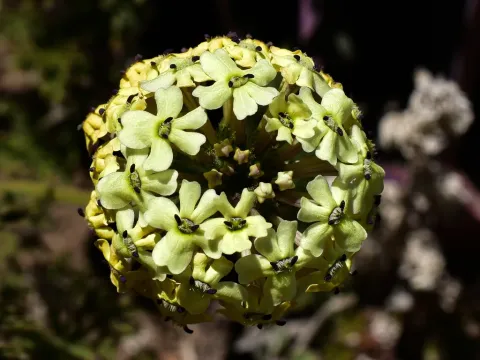
Glandularia
Glandularia
Glandularia is typically propagated by seeds started indoors, as the plants require a head start to ensure a long and prolific blooming season.
What the section contains
 Garden verbena
Glandularia x hybrida (hort. ex Groenl. & Rümpler) G.L. Nesom & Pruski x G. aristigera (S. Moore) Tronc.
Garden verbena
Glandularia x hybrida (hort. ex Groenl. & Rümpler) G.L. Nesom & Pruski x G. aristigera (S. Moore) Tronc.
 Glandularia aristigera
 (S. Moore) Tronc.
Glandularia aristigera
Glandularia aristigera (S. Moore) Tronc.
 Glandularia bipinnatifida
 (Nutt.) Nutt.
Glandularia bipinnatifida
Glandularia bipinnatifida (Nutt.) Nutt.
 Glandularia corymbosa
 (Ruiz & Pav.) N. O’Leary & P. Peralta
Glandularia corymbosa
Glandularia corymbosa (Ruiz & Pav.) N. O’Leary & P. Peralta
 Glandularia elegans
 (Kunth) Umber
Glandularia elegans
Glandularia elegans (Kunth) Umber
 Glandularia laciniata
 (L.) Schnack & Covas
Glandularia laciniata
Glandularia laciniata (L.) Schnack & Covas
 Glandularia peruviana
 (L.) Small
Glandularia peruviana
Glandularia peruviana (L.) Small
 Glandularia subincana
 Tronc.
Glandularia subincana
Glandularia subincana Tronc.
 Glandularia tenera
 (Spreng.) Cabrera
Glandularia tenera
Glandularia tenera (Spreng.) Cabrera
 Rose vervain
Glandularia canadensis (L.) Nutt.
Verbena hybrida
Glandularia x hybrida x Glandularia peruviana
Verbena hybrida
Glandularia x hybrida (hort. ex Groenl. & Rümpler) G. L. Nesom & Pruski
Rose vervain
Glandularia canadensis (L.) Nutt.
Verbena hybrida
Glandularia x hybrida x Glandularia peruviana
Verbena hybrida
Glandularia x hybrida (hort. ex Groenl. & Rümpler) G. L. Nesom & Pruski
Glandularia
Seeds should be sown in late winter in a well-draining seed-starting mix, with temperatures maintained between 20°C and 25°C to promote germination.
Since germination can be erratic, it is recommended to keep the containers covered to maintain consistent humidity until seedlings emerge.
Pricking out the seedlings into individual pots once they reach the two-leaf stage helps build a robust root system, essential for transplant success.
Hardening off the plants before transferring them to their permanent location in the garden is crucial to avoid transplant shock due to temperature fluctuations.
Belonging to the Verbenaceae family, Glandularia is a sun-loving plant that thrives in warm, temperate climates and requires full sunlight to perform best.
The ideal soil for this crop is light, sandy, or loamy with excellent drainage, as the plant is sensitive to waterlogged conditions that cause root decay.
Though naturally drought-tolerant once established, supplemental watering is necessary during prolonged dry spells to maintain high flower production.
Fertilization with balanced nutrients throughout the active growing period encourages continuous branching and a dense, bushy growth habit.
Strategic placement in the landscape is important, as Glandularia performs exceptionally well in borders, hanging baskets, and rock gardens with good airflow.
Powdery mildew is the most common fungal disease affecting Glandularia, especially in areas with high humidity and poor circulation between plants.
Root rot, caused by overwatering or compacted soil, can quickly destroy the plant, making proper irrigation management the top priority for growers.
Aphids are a frequent pest, particularly targeting new growth and flower buds, which can lead to stunted development if left untreated.
Spider mites are another significant threat, particularly in hot and dry weather, causing the foliage to appear speckled and eventually wither.
Integrated pest management, including regular inspection and the use of targeted insecticides or fungicides, is recommended to keep the crop healthy.