
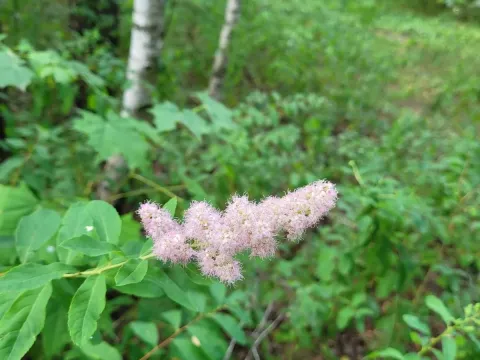
Menzies spirea
Spiraea menziesii
Menzies spirea (Spiraea menziesii) is a perennial deciduous shrub belonging to the Rosaceae family. Native to North America, this plant is naturally adapted to moist forest margins and wetlands, which dictates its preference for specific environmental conditions in horticultural settings.
What the section contains
Menzies spirea
The shrub thrives in full sun to light shade, requiring fertile, moist, and well-drained soil. It is particularly well-suited for gardens with higher soil moisture, although it demonstrates a strong ability to adapt to various garden conditions if provided with sufficient irrigation.
Agricultural management primarily involves spring pruning, which is essential to maintain the shape of the shrub and promote vigorous flowering. Since the plant produces flowers on current-season wood, pruning should be done before the growth phase begins to ensure a dense floral display.
Botanically, Menzies spirea is characterized by its upright habit, often reaching heights of 1.5 to 2 meters. Its foliage is oval-shaped and serrated, while its most notable feature is the vibrant pink to purple terminal panicles that bloom throughout the mid-summer season.
In terms of usage, the plant is widely utilized in professional landscaping for formal and informal hedges, mass plantings, and erosion control on slopes. Its high tolerance to wet sites makes it an excellent choice for stabilizing soil near ponds and streams in park architecture.
Common pests affecting Menzies spirea include aphids and spider mites. These insects can proliferate during dry, hot spells, attacking the foliage and stems. Integrated pest management using insecticidal soaps or systemic pesticides is recommended to keep populations under control.
Disease issues such as leaf spot and powdery mildew may occur in poorly ventilated areas or under high humidity. To prevent these infections, gardeners should ensure proper spacing between individual plants and perform regular thinning to allow for adequate air circulation through the shrub.