
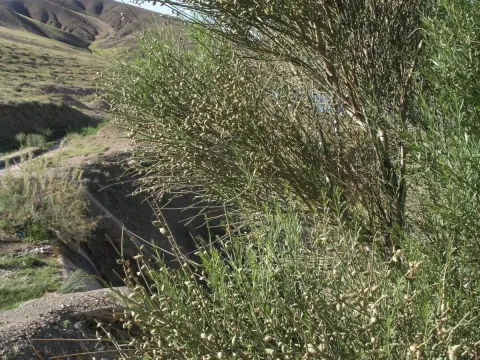
Desert almond
Prunus scoparia
The desert almond (Prunus scoparia) is a deciduous shrub belonging to the Rosaceae family. It is a highly specialized xerophytic species capable of thriving in some of the most arid and challenging environments on the planet.
What the section contains
Desert almond
Its native range extends across the mountainous regions of Iran, Afghanistan, and parts of Central Asia. The shrub is uniquely adapted to thrive on stony, nutrient-poor substrates where other fruit-bearing species would struggle to survive.
Morphologically, the desert almond is characterized by a deep, expansive root system that allows it to access soil moisture stored in deep crevices, ensuring survival during prolonged droughts. It requires full sun exposure for optimal growth.
Soil requirements for Prunus scoparia focus primarily on drainage. The species is highly sensitive to waterlogging, which can cause root rot and rapid decline; therefore, light, well-draining soils are essential for plantation establishment.
While the plant is remarkably heat-tolerant, it requires specific thermal conditions for flower bud development. Because it blooms very early in the spring, protection from late frost is vital to ensure successful fruit set.
The primary agricultural use of the desert almond is the production of kernels, which are highly valued for their oil content and distinct flavor. They are widely utilized in the food processing industry and for direct consumption.
Yield potential is dependent on stand management and local climate stability. Although typically lower-yielding than commercial sweet almond orchards, the desert almond offers resilience and reliability in environments where traditional almond varieties cannot grow.
Harvesting usually occurs when the outer hull begins to split and dry out. Careful timing is necessary to prevent premature fruit drop and ensure that the nuts are harvested at their peak quality.
Beyond food production, the desert almond serves an important ecological role. It is frequently employed in soil conservation projects to stabilize slopes and prevent wind or water erosion in arid mountainous regions.
Furthermore, it is a significant nectar source for pollinators early in the season. Its early bloom provides essential resources for bees, making it a valuable addition to integrated farming systems that prioritize biodiversity.
Fungal diseases, specifically shot-hole disease (Stigmina carpophila), represent a significant threat to the crop. These pathogens thrive under humid conditions, making management difficult during wet spring months.
Insect pests, most notably the almond seed wasp (Eurytoma amygdali), pose a major challenge. The larvae infest the fruit and destroy the kernel, leading to substantial yield losses if not managed with proper biological or chemical controls.
Sanitation practices are the cornerstone of disease prevention for this shrub. Regularly removing mummy nuts left on the branches and pruning away infected growth helps reduce the inoculum load for the following season.
Chemical applications, when necessary, should be timed strategically during the budding and post-bloom stages. Using systemic insecticides can provide effective protection against internal fruit feeders.
While Prunus scoparia is a robust species, its health depends heavily on the maintenance of an open, airy canopy. Strategic pruning ensures good airflow, which helps mitigate the development of moisture-dependent fungal infections.