
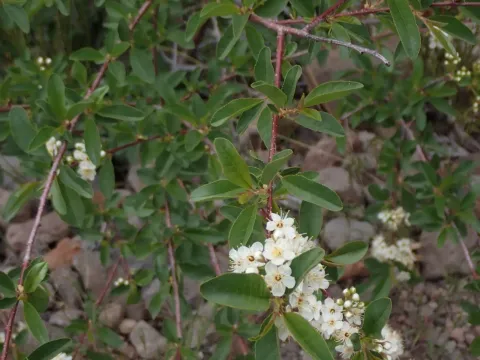
Bitter cherry
Prunus emarginata
The bitter cherry (Prunus emarginata) is a member of the Rosaceae family. This deciduous tree or large shrub is native to western North America, typically found in moist forests, canyons, and along stream banks, showcasing strong ecological adaptability.
What the section contains
Bitter cherry
The plant thrives in well-drained, nutrient-rich soils. While it can handle various soil types, it performs best in slightly acidic to neutral environments. Its root system is moderately deep, helping the tree stabilize soil on slopes and resist moderate periods of moisture deficit.
Climatically, the bitter cherry is quite hardy, capable of surviving cold winters. It prefers full sun exposure for maximum foliage density and fruit production, but it can also tolerate partial shade in hotter climates where protection from the midday sun is beneficial.
Botanically, it is recognized by its smooth, reddish-brown bark that peels in horizontal strips as the tree matures. The leaves are distinctively notched at the tip, which is the defining feature leading to the species name emarginata.
In terms of human use, the bitter cherry is primarily cultivated for ornamental purposes and habitat restoration. Its small, bitter fruits are rarely consumed by humans, but they are a critical food source for birds, bears, and other wildlife in the ecosystem.
The bitter cherry is susceptible to several pathogens common to the Prunus genus. Powdery mildew can occur during humid summers, covering leaves in a white fungal layer and reducing the plant's photosynthetic efficiency.
Black knot is a more serious disease that causes dark, gnarled swellings on the branches. Affected branches must be pruned several inches below the knot and burned to prevent the spread of fungal spores to healthy parts of the canopy.
Aphids are common pests that colonize tender new growth. While they rarely kill mature trees, heavy infestations can cause leaf curling and stunt growth, necessitating the use of horticultural soaps or systemic insecticides if the population explodes.
Tent caterpillars are another significant pest, capable of defoliating entire branches. Monitoring for egg masses in winter and manually removing small webs in early spring are the most effective non-chemical methods for managing these larvae.
Proper air circulation is the best preventative measure against most foliage diseases. Ensuring the tree is not planted too densely and keeping the surrounding ground free of accumulated leaf litter will significantly lower the risk of recurring pest and disease issues.