
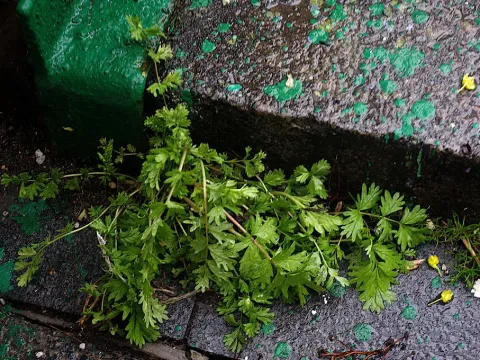
Bush cinquefoil
Potentilla supina
Potentilla supina, known as bush cinquefoil or prostrate cinquefoil, belongs to the Rosaceae family. It is an annual or biennial herbaceous plant characterized by prostrate stems that often root at the nodes, allowing it to spread effectively across open fields.
What the section contains
Bush cinquefoil
Originating from temperate regions of Eurasia and North America, this plant has become a widespread weed in various agricultural systems. It prefers moist, nitrogen-rich soils, making it particularly problematic in irrigated fields and near water bodies.
The plant exhibits high ecological adaptability, surviving in compacted or waterlogged soils where many other species fail to thrive. This makes it a persistent competitor for water and nutrients in many cropping systems.
Its taproot system is well-developed, enabling the plant to withstand drought conditions during later stages of growth. Seeds are prolific and can remain dormant in the soil seed bank for several seasons, complicating long-term management.
In terms of agricultural significance, P. supina causes considerable yield reductions by competing with staple crops for essential resources. It also creates dense ground cover that prevents proper soil aeration in early growth stages of crops.
Potentilla supina serves as an alternative host for various plant pathogens, including powdery mildew and rust fungi. These diseases can migrate from the weed population to commercial crop fields, leading to widespread infection.
Pest populations, such as aphids and leaf beetles, frequently utilize the plant as a refuge. This allows these pests to persist on the farm during off-seasons and move to sensitive crops, increasing the risk of significant damage.
Managing the weed is complicated by its vegetative propagation capability. If soil cultivation is shallow, detached nodes can re-root, effectively leading to further spread rather than the elimination of the weed population.
Effective control requires an integrated approach, utilizing timely cultivation, crop rotation, and selective herbicides. It is crucial to manage the weed before it sets seed to prevent further build-up in the soil seed bank.
Monitoring the fields for early detection of P. supina is vital. Producers should focus on maintaining healthy crop canopies to shade out the weed and minimize its development throughout the growing season.