
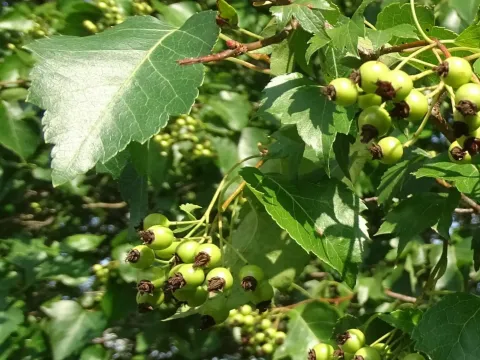
Washington hawthorn
Crataegus phaenopyrum
Washington hawthorn can be propagated through seeds or cuttings. Seeds require a cold stratification period of several months, making fall sowing in outdoor seedbeds the most effective natural method for germination.
What the section contains
Washington hawthorn
If sowing in containers, seeds must be kept in a cold, moist environment to break dormancy. Germination is often uneven and may occur over two years, requiring patience from the grower.
Vegetative propagation via softwood cuttings taken in late spring is a common practice for maintaining cultivar characteristics. Using rooting hormone significantly improves the success rate in nursery conditions.
Transplanting should be done while the plant is dormant. Ensure the planting hole is twice the width of the root ball to allow for proper root expansion in the surrounding soil.
Young trees require consistent moisture during their first growing season to establish a robust root system. Once established, they become significantly more drought-tolerant and resilient.
Crataegus phaenopyrum, commonly known as Washington hawthorn, belongs to the Rosaceae family. It is a highly valued ornamental tree, particularly noted for its glossy foliage that turns brilliant red and orange in autumn.
This species thrives in a wide range of soil types, including heavy clay, as long as it has decent drainage. It exhibits excellent adaptability to urban environments and polluted air conditions.
Full sun is required for optimal flowering and fruit production. While the tree can tolerate partial shade, it may produce fewer flowers and display a less compact form under restricted light levels.
Maintenance involves routine pruning to shape the canopy or to create dense hedges. The thorns are characteristic of the species, making it an excellent choice for security-focused landscaping.
The tree is hardy and can withstand varying climate conditions, from hot summers to freezing winters. It is a low-maintenance choice for parks, gardens, and street-side planting projects.
Like many members of the Rosaceae family, Washington hawthorn is susceptible to cedar-hawthorn rust and fire blight. These diseases are the most common challenges for growers in humid climates.
Pests such as aphids, scale insects, and lace bugs can occasionally cause damage to foliage. Integrated pest management strategies are recommended to keep populations below damaging thresholds.
Proper spacing between plants is crucial to ensure adequate airflow, which helps reduce the humidity levels that favor fungal infections on the leaves and branches.
Early detection of disease symptoms, such as wilting branches or spotted leaves, is vital. Affected parts should be pruned promptly and tools must be sanitized to prevent spread.
- Monitoring for pest outbreaks.
- Applying dormant oil sprays.
- Selecting rust-resistant locations.