
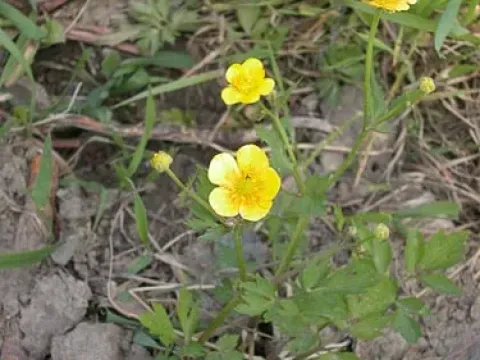
Creeping buttercup
Ranunculus reptabundus
Creeping buttercup (Ranunculus reptabundus) is a perennial herbaceous plant belonging to the Ranunculaceae family. It is widely recognized for its aggressive spreading habit, facilitated by long, creeping above-ground stems known as stolons.
What the section contains
Creeping buttercup
The botanical structure of the plant consists of ternate leaves and bright yellow flowers. Its primary survival strategy involves nodes along the stolons that develop adventitious roots, allowing the plant to colonize new areas rapidly and efficiently.
The plant thrives in moist, heavy soils, particularly in clay or loamy conditions that maintain high humidity. It is frequently observed in pastures, riparian zones, and fields with inadequate drainage systems, where it often forms dense mats.
Originally native to Eurasia, the creeping buttercup has established a significant presence in temperate regions globally. Its adaptability to diverse soil moisture levels makes it a resilient inhabitant of both wild and cultivated landscapes.
In agricultural practice, it is considered a problematic weed in meadows and pastures. It contains a toxin called protoanemonin, which can cause skin irritation in humans and digestive distress in livestock if consumed in large quantities while fresh.
The main threat posed by the creeping buttercup is its competitive nature, which displaces high-quality forage grasses. By forming thick vegetative cover, it effectively limits the available space and nutrients for desirable crop species.
Disease outbreaks, such as powdery mildew, can affect the plant during periods of high humidity and poor ventilation. However, these diseases rarely eradicate the population and usually serve only as minor stressors.
Pests such as specialized beetles and larvae can feed on the foliage, but the plant's chemical defenses generally mitigate the impact of such attacks. Therefore, natural biological control is rarely sufficient to manage infestations.
Management strategies focus heavily on improving soil drainage, as the species is highly sensitive to dry soil conditions. Improving the physical state of the soil often leads to the natural decline of buttercup density over time.
Mechanical cultivation, such as deep plowing, is effective in disrupting the root system. For chemical control, selective herbicides must be applied carefully to avoid damage to surrounding legumes and other sensitive crops within the pasture system.