
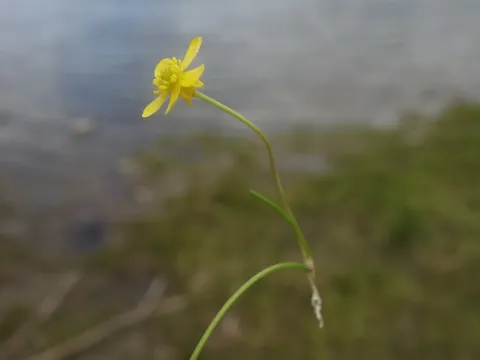
Creeping spearwort
Ranunculus reptans
Creeping spearwort (Ranunculus reptans) is a perennial herbaceous plant belonging to the Ranunculaceae family. It is a highly specialized species adapted to damp and riparian environments, distinct from many of its terrestrial relatives in the genus.
What the section contains
Creeping spearwort
The plant is native to the northern temperate and boreal regions of Eurasia and North America. It predominantly grows in areas with sandy or silty substrate, commonly found along lake shores, river banks, and marshy meadows that experience seasonal water level changes.
From a botanical standpoint, the plant is characterized by its prostrate, creeping stems that root at the nodes. This growth habit allows it to spread rapidly across wet surfaces, forming thin, wire-like mats that are highly efficient at colonizing open ground.
Its environmental requirements focus on high moisture availability and sufficient solar radiation. The plant is an obligate wetland species, meaning it cannot survive in dry or well-drained soils, as its root system requires consistent water supply for metabolic activities.
Regarding its utility, the plant is not a standard agricultural crop. Its historical significance is largely ecological, as it functions as a natural soil binder in wetlands. It contains toxic compounds like protoanemonin, making it unpalatable for grazing livestock.
The plant can be susceptible to various fungal pathogens, specifically those causing leaf spot or powdery mildew under conditions of high humidity and poor air circulation. These diseases are more common when the plant grows in dense, non-ventilated clusters.
In terms of pests, it is subject to attacks by specific beetles and leaf miners that feed on the Ranunculaceae family. While these interactions are part of the natural balance in wetland ecosystems, heavy infestation can retard the growth of individual runners.