
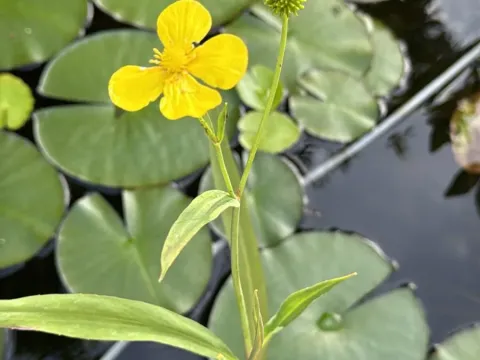
Greater spearwort
Ranunculus lingua
Greater spearwort (Ranunculus lingua) is a perennial herbaceous plant belonging to the Ranunculaceae family. It is native to temperate regions across Eurasia, typically found inhabiting marshes, fens, and the margins of ponds or slow-moving water bodies.
What the section contains
Greater spearwort
This species is classified as a hydrophyte, which means it requires high water availability for optimal growth. It thrives in muddy or organic-rich soils that remain saturated throughout the growing season, often tolerating water depths of up to 30 centimeters.
The botanical structure of the plant is marked by its rhizomatous habit, allowing for extensive clonal spread. Its lanceolate or tongue-shaped leaves, from which the name 'lingua' is derived, provide a distinct appearance, complemented by large, bright yellow flowers.
Regarding climate and soil, the plant favors sunny locations, though it can adapt to partial shade. It is well-suited to regions with cool to moderate climates, demonstrating significant hardiness during the winter months, provided the rhizomes remain protected by water or mud.
Economically, Ranunculus lingua is primarily cultivated as an ornamental plant for water gardens and aquatic landscape restoration. Its ability to thrive in wet conditions makes it an excellent choice for phytoremediation efforts in naturalizing pond edges and filtration zones.
The most common disease affecting Greater spearwort is powdery mildew, which typically develops during periods of high humidity and poor air circulation in dense clusters. Prompt thinning is recommended to maintain plant health and aesthetic quality.
Insect pests such as leaf-eating beetle larvae and sawfly larvae can cause aesthetic damage to the foliage. While these rarely kill the plant, they can reduce its photosynthetic capacity and overall vigor, necessitating manual removal or biological intervention.
Like many members of the Ranunculaceae family, the plant contains protoanemonin. This chemical compound acts as a natural defense mechanism against herbivores, making the plant toxic to most grazing animals and requiring caution during handling.
Root rot is a potential threat if the water quality is poor or if the substrate becomes anaerobic for extended periods. Maintaining water circulation is crucial to ensuring that the root system receives sufficient oxygen to support healthy growth.
Invasive behavior is a major factor to manage when cultivating this species. Because it spreads rapidly via rhizomes, it can quickly overwhelm neighboring aquatic plants. Using containment structures or dedicated planting zones is a standard agronomic practice for this species.