
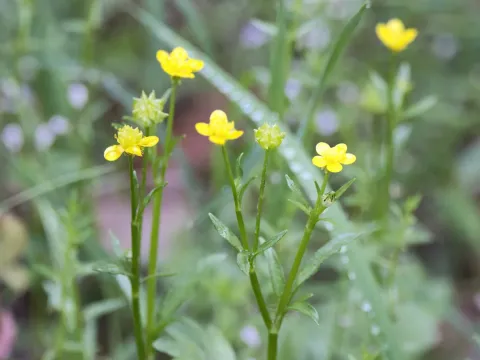
Hairy buttercup
Ranunculus sardous
Hairy buttercup, or Ranunculus sardous, belongs to the Ranunculaceae family and is recognized as an annual herbaceous plant. It is primarily found in damp meadows, pastures, and disturbed soil areas where moisture levels remain consistently high.
What the section contains
Hairy buttercup
The species thrives in heavy, clay-rich soils that retain nutrients effectively. Its biological adaptation to waterlogged conditions makes it a significant competitor for space against forage grasses in agricultural environments.
Climatically, this plant prefers temperate regions with abundant spring rainfall. It requires significant solar radiation for growth and development, often failing to thrive in areas shaded by taller canopy vegetation.
Management practices include soil drainage improvement and careful monitoring of pasture health. Because the plant is prolific in seed production, preventing the seed set is a vital part of its lifecycle control in fields.
Economically, it is classified as a toxic weed due to the presence of protoanemonin. Livestock usually avoid it in the pasture, but contamination in hay can cause digestive issues for animals upon consumption.
Hairy buttercup poses a threat to biodiversity within grasslands, as it can quickly colonize patches of land with its rapid growth habit and high germination rate.
Regarding diseases, it can act as an alternate host for various pathogens, including mildews and rust fungi that threaten essential forage species.
Pest populations that frequent the plant include various insects, which may utilize the dense growth of buttercup as a refuge before migrating to crops.
Chemical control is generally effective using selective herbicides, but the timing of the application is crucial; it must occur before the plant reaches its full reproductive stage.
Physical removal methods, such as mowing or tillage, must be performed with precision to prevent the spread of seeds, which remain viable in the soil seed bank for extended periods.