
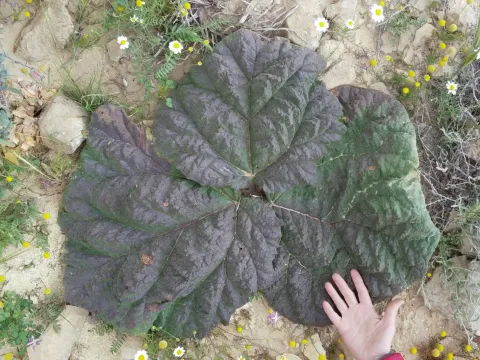
Palestine rhubarb
Rheum palaestinum
Palestine rhubarb (Rheum palaestinum) is a perennial herbaceous plant belonging to the Polygonaceae family. It is a highly specialized species native to the harsh desert regions of the Negev and Jordan, where it exhibits remarkable adaptation to extreme drought.
What the section contains
Palestine rhubarb
The botanical structure of this plant is unique among rhubarbs. Its large, leathery leaves are arranged in a rosette with distinct grooves that channel rainwater directly to the base of the plant, ensuring the roots receive water even during minimal rainfall events.
Soil requirements for this species are specific: it demands rocky or sandy soils with exceptional drainage. The plant develops a deep taproot that penetrates the ground to access stored moisture in lower soil horizons, which is vital for survival during the hot summer months.
The climate must be arid with significant fluctuations between seasonal temperatures. The plant is perfectly suited for intense sunlight and high heat but is highly sensitive to humidity and waterlogged soil conditions, which can lead to rapid decay of the root system.
Cultivation techniques for Rheum palaestinum are strictly experimental. There is no large-scale commercial farming for this species, as its slow growth rate and niche ecological requirements make it unsuitable for traditional field crop management.
Economic use of Palestine rhubarb is currently non-existent on a commercial scale. Due to its status as a rare and protected species in its natural habitat, it is not harvested for food or fiber production.
The plant serves as a critical subject for environmental research. Scientists investigate its water-harvesting leaf architecture to gain insights for biomimetic engineering, specifically for developing more efficient irrigation solutions for arid land agriculture.
Harvesting individuals from the wild is strictly prohibited by law in its native range. Any form of collection is restricted to approved botanical research activities aimed at understanding how to mitigate the effects of climate change on desert vegetation.
In the future, the chemical properties of the plant may be explored for potential medical or industrial applications, as other members of the Polygonaceae family are known to contain various bioactive compounds.
The primary management goal for this species is preservation. Ensuring the protection of its natural habitat is the priority, rather than active exploitation or development as an agricultural commodity.