
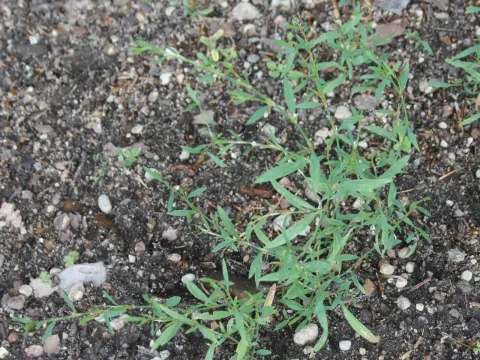
Narrow-leaved knotweed
Polygonum rurivagum
Narrow-leaved knotweed (Polygonum rurivagum) belongs to the Polygonaceae family. While often viewed as a spontaneous species, its agronomic value lies in its role as a resilient forage crop for marginal soils and land reclamation projects.
What the section contains
Narrow-leaved knotweed
Sowing should take place in early spring once soil temperatures reach about 5 to 8 degrees Celsius. The seeds have a high germination rate and long-term viability, allowing them to establish well in various climatic conditions.
Surface sowing followed by rolling is recommended to ensure optimal seed-to-soil contact. Keeping the seeding depth shallow, roughly 1 to 2 centimeters, is essential for rapid emergence and efficient root development.
The plant demonstrates vigorous growth during the long days of the growing season. Once established, it creates a dense cover that helps prevent soil erosion, making it an excellent choice for stabilizing degraded sites.
As a self-seeding plant, it maintains its presence in the field through natural regeneration. Managed stands can last for many years without the need for periodic re-sowing if proper harvesting practices are maintained.
This species is highly adaptable and requires minimal soil fertility. It thrives in sandy, loamy, and even compacted soils where other forage crops struggle to survive or provide any significant yield.
Narrow-leaved knotweed is exceptionally drought-tolerant. Its deep taproot system allows it to access water from deeper soil horizons, making it a reliable choice for arid or semi-arid agricultural regions.
It prefers full sun exposure to maximize photosynthetic efficiency and vegetative biomass production. Shaded environments tend to stunt its growth and reduce the nutritional density of the plant material.
The plant is not sensitive to soil pH and performs well across a wide range of acidity or alkalinity. This versatility allows farmers to utilize land that is typically unsuitable for conventional high-input crops.
Temperature requirements are quite flexible. The species is well-adapted to moderate climates, enduring both late spring frosts and intense summer heat without significant impact on its overall vitality.
The yield of narrow-leaved knotweed varies based on the site's environmental conditions. In well-managed stands with adequate rainfall or light fertilization, it can produce substantial biomass for hay or grazing.
Peak biomass yield occurs during the flowering stage, which is the ideal time for harvesting to ensure the best balance of protein and crude fiber for livestock feed. It can be cut multiple times in a season.
The forage is generally well-accepted by sheep and goats. Its nutritional profile makes it a useful component in mixed pastures, helping to provide steady grazing capacity throughout the spring and summer months.
Seed production is an important secondary yield. Because the plant is highly prolific, seeds can be harvested and used for ecological restoration or as part of proprietary seed blends for low-maintenance landscaping.
Overall yields can be improved by integrating the species into a polyculture system. Companion planting with nitrogen-fixing legumes can significantly enhance soil quality and the nutritional value of the harvest.
The primary threats include fungal diseases like powdery mildew, which can develop if the plant is grown in highly humid or stagnant air conditions. Good field management and spacing are key to prevention.
Insect pests, specifically soil-dwelling larvae such as wireworms, can damage the root systems of young plants. Aphid infestations may also occur during prolonged dry spells, impacting leaf development.
Crop rotation remains the most effective defense strategy. Avoid planting knotweed in areas previously used by other Polygonaceae species to prevent the buildup of soil-borne pathogens and specific pests.
Chemical control is rarely necessary for this robust species. Integrated pest management, focusing on sanitation and maintaining vigorous plant health, is usually sufficient to minimize economic damage.
Monitoring the fields during the flowering period is crucial. Early detection of any viral symptoms or pest pressure allows for localized interventions, protecting the overall health and uniformity of the stand.
Harvesting for green fodder should be performed at the start of the flowering phase. At this time, the plant contains the highest level of essential nutrients and is most palatable for livestock consumption.
Standard mowing equipment is used, ensuring a clean cut at a height of 5 to 7 centimeters. This preserves the crown of the plant and encourages rapid regrowth for a subsequent harvest later in the season.
When producing hay, the crop requires thorough drying. Because the stems hold moisture, turning the windrows frequently is necessary to ensure the material is sufficiently dehydrated before storage.
Seed harvest is conducted when the seeds turn dark and the shell hardens. Harvesting should be done promptly to avoid significant loss due to natural seed shattering, which occurs readily in mature plants.
Storage facilities for the harvested material must be dry and well-ventilated. Proper storage prevents mold development and ensures that the forage remains safe and nutritious for off-season use.