
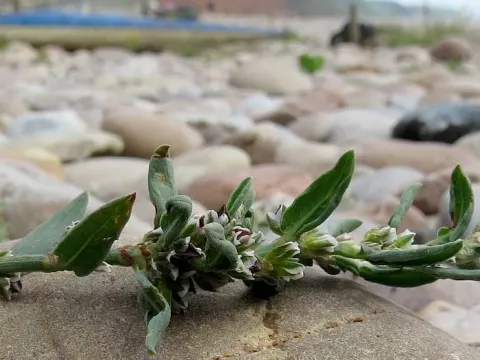
Ray's knotgrass
Polygonum oxyspermum
Ray's knotgrass (Polygonum oxyspermum) is an annual herbaceous plant belonging to the Polygonaceae family. This species is specifically adapted to coastal environments, frequently found colonizing sandy beaches and shifting dunes throughout its European native range.
What the section contains
Ray's knotgrass
The plant exhibits remarkable physiological tolerance to saline soil conditions, classifying it as a halophyte. Its distribution is largely restricted to the coastal zones of Northern and Western Europe, where it thrives in environments characterized by high salt spray and significant wind exposure.
Morphologically, Ray's knotgrass features sprawling, branching stems that provide a low-profile ground cover. The leaves are typically narrow and lanceolate, while its small, inconspicuous flowers appear in clusters at the leaf axils, a characteristic trait of the genus Polygonum.
This species requires high levels of solar radiation and well-drained, nutrient-poor sandy substrates to develop properly. Unlike typical agricultural crops, it does not require conventional fertilization, as it is naturally suited for the harsh, low-nutrient conditions found on coastal fringes.
In terms of ecological utility, Ray's knotgrass is instrumental in stabilizing coastal substrates. Its root network helps to bind shifting sands, acting as a natural mechanism to prevent soil erosion and facilitate the development of more complex plant communities on coastal dunes.