
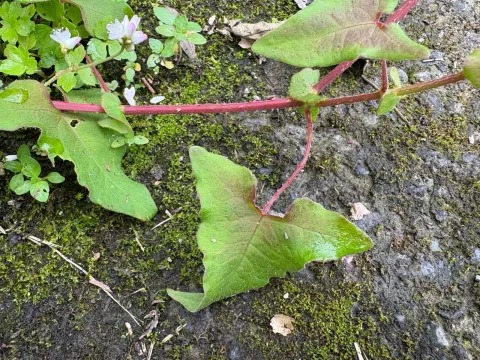
Persicaria senticosa
Persicaria senticosa
Persicaria senticosa, commonly known as prickly knotweed, belongs to the Polygonaceae family. This perennial herbaceous plant is native to East Asia, thriving naturally across China, Japan, and the Korean Peninsula.
What the section contains
Persicaria senticosa
The plant is botanically distinct due to its trailing or climbing stems armed with sharp prickles. Its leaves are typically arrowhead-shaped, often featuring a decorative dark central blotch, which contributes to its aesthetic appeal in landscape applications.
Cultivation requires moist, nutrient-rich soil with excellent drainage. While it tolerates a variety of conditions, it performs best in partial shade, mimicking its natural woodland habitat where it receives diffused, indirect light.
In terms of agricultural management, Persicaria senticosa is highly vigorous and considered invasive in many regions outside its native range. Growers must implement strict containment strategies to prevent the plant from dominating nearby ecosystems.
Beyond its use in horticulture for covering fences and structures, the plant is harvested for its pharmacological potential. Research indicates the presence of bioactive compounds that have been utilized in traditional medicine for centuries.
The primary threats to Persicaria senticosa include fungal pathogens such as powdery mildew, which thrive in stagnant, humid environments with poor air circulation.
Common pests affecting the crop involve aphids and spider mites. These insects tend to colonize the undersides of the leaves or young, tender stems, causing yellowing and premature defoliation if left untreated.
Integrated pest management (IPM) is highly recommended to protect the integrity of the plant, especially when it is being grown for medicinal extraction purposes where chemical residues must be avoided.
Cultural control methods, such as thinning the canopy to improve airflow and carefully managing irrigation levels, are effective in reducing the prevalence of common diseases.
Constant monitoring during the growing season allows for early detection of pest outbreaks, enabling targeted intervention that preserves the overall health of the planting area.