
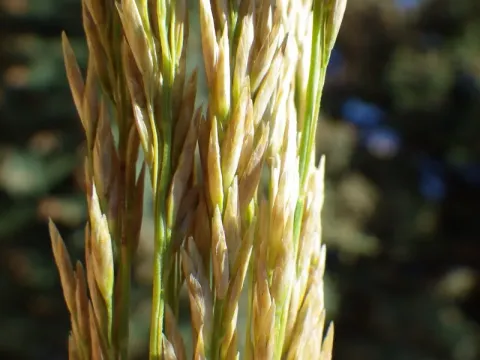
Plains bluegrass
Poa arida
Plains bluegrass (Poa arida) is a perennial grass species belonging to the Poaceae family, natively adapted to dry and sandy environments.
What the section contains
Plains bluegrass
Sowing is typically performed in late autumn to utilize natural winter stratification, which significantly improves germination rates in the spring.
When seeding, it is essential to ensure shallow placement in the soil, ideally not deeper than 1–2 centimeters, to allow the delicate seedlings to emerge.
Plains bluegrass can spread through rhizomes, meaning that even moderate initial plant density can eventually result in a uniform vegetative cover.
It is often integrated into seed mixtures for rangeland restoration, providing a resilient component that establishes well even in challenging conditions.
As the name Poa arida suggests, this species is highly resistant to drought and thrives in semi-arid and arid regions of North America.
The plant demonstrates remarkable tolerance to alkaline and saline soils, making it an excellent choice for stabilizing disturbed or degraded land.
Optimal growth requires full sun exposure; this species does not perform well in shaded areas where competition for resources can be intense.
It possesses excellent cold-hardiness and is capable of surviving extreme temperature fluctuations typical of continental climate zones.
Although it does not demand high soil fertility, applications of nitrogen can boost green matter production in reclaimed land projects.
The primary agricultural use of plains bluegrass is for grazing livestock, as it offers good palatability in the early to mid-growing stages.
While yield volumes are generally lower compared to irrigated crops, its ability to persist during drought periods ensures a reliable forage source.
It serves as a vital component for erosion control, anchoring soil on steep slopes and plains where wind erosion is a major concern.
In hay production, it provides high-quality forage if harvested before the stalks become too coarse and lignified.
Sustainable grazing management is key to maintaining yield, as it allows the plant to replenish its root energy reserves for subsequent seasons.
Plains bluegrass is naturally robust, having evolved under harsh conditions that limit the pressure from many common agricultural pathogens.
In seasons with abnormally high rainfall, susceptibility to rusts or foliar fungal diseases may increase if air circulation in the stand is poor.
Pests such as grasshoppers or cutworms can occasionally cause localized damage, but the plant's growth vigor often allows for quick recovery.
- Monitoring plant density helps in identifying early signs of stress or pest colonization.
- Avoiding overgrazing is the most effective management tool to prevent pest outbreaks.
The species generally requires little to no chemical intervention, making it a sustainable choice for extensive land management.
For hay production, harvesting should be timed during the boot stage to ensure the optimal balance between biomass volume and nutrient content.
Rapid curing of the cut material is recommended to preserve color and protein levels before the volatile nutrients are lost to oxidation.
Seed harvest requires precision as the seeds are fine; harvesting should occur when the heads turn straw-colored but before shattering.
Management of the pasture requires rotational grazing to allow for periods of rest, ensuring the root systems remain healthy and productive.
Properly harvested and stored forage from plains bluegrass maintains its quality, providing a nutritious feed supplement for cattle throughout winter.