
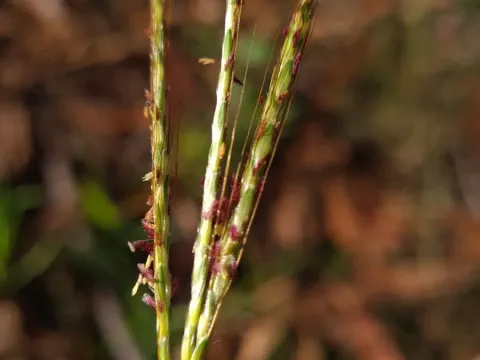
Pitted blue grass
Bothriochloa decipiens
Pitted blue grass (Bothriochloa decipiens) is a perennial grass belonging to the Poaceae family. Native to Australia, it is well-regarded for its resilience and ability to thrive in a wide variety of ecological conditions, from open woodlands to pasture environments.
What the section contains
Pitted blue grass
Botanically, this species grows in loose tussocks, typically reaching a height of 30 to 90 cm. It is easily identifiable by its hairy leaves and specific inflorescences, which possess small pits on the glumes, giving the species its common name. The plant has a robust root system, which is crucial for its survival.
Soil requirements for Bothriochloa decipiens are quite flexible. It is known for growing well on heavy clay, stony soils, and even soils with low fertility. Good drainage is preferred, but the plant displays a remarkable ability to withstand moisture stress in various environments.
The climate requirements emphasize its adaptation to warm-season conditions. As a C4 grass, it photosynthesizes efficiently in high heat and high light intensity. It remains productive during summer periods when many cool-season grasses become dormant, making it a valuable asset for grazing.
The agricultural use of this grass is primarily focused on livestock production. It serves as a reliable, long-lasting perennial pasture component that can sustain grazing pressure, provided the management strategy allows for sufficient recovery time between grazing events.
Common threats to this species include leaf rust and other fungal pathogens that may proliferate during prolonged periods of high humidity. Proper pasture management and ensuring adequate air circulation through appropriate stocking rates are essential to mitigate these issues.
Insects, particularly grass-feeding caterpillars and certain beetles, can occasionally cause damage to the foliage. Monitoring the pasture for increased insect activity is recommended, especially in regions with a history of recurrent pest infestations.
Root-knot nematodes can potentially affect the plant's vigor in specific soil types. Crop rotation or the incorporation of other compatible pasture species can help maintain a healthy soil balance and reduce nematode pressure.
Environmental stress, such as extreme frost or prolonged flooding, may temporarily reduce the biomass productivity of the grass. However, its strong root structure generally allows for quick recovery once conditions return to the optimal range.
Overall, Bothriochloa decipiens is considered a hardy species with low maintenance requirements. Its natural resistance to many pests and diseases makes it a preferred choice for sustainable, low-input grassland management systems.