
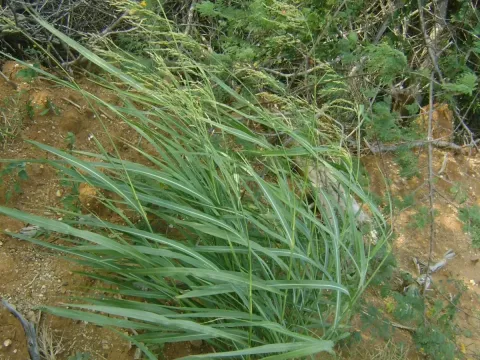
High rice
Oryza alta
High rice (Oryza alta) belongs to the Poaceae family. This species, often found in specific wild habitats, requires unique environmental conditions for germination compared to commercial rice varieties.
What the section contains
High rice
Sowing should take place when soil temperatures consistently reach 15-18 degrees Celsius. Adequate moisture is essential during this stage, as the seeds are highly sensitive to desiccation.
Seedbed preparation requires deep tillage, reaching 10-15 centimeters. The soil must be well-aerated to support initial root development while maintaining proper moisture levels for the seeds.
Seeds should be planted at a depth of 2-3 centimeters. Correct depth is vital to ensure uniform emergence, as shallow planting risks drying out, while too deep planting can exhaust the seed reserves.
Crop rotation should be carefully planned. It is recommended to avoid fields that previously hosted heavy cereal diseases to prevent the accumulation of pathogens in the soil.
High rice has high water demands. While it can tolerate periodic flooding, it thrives best when there is a proper balance between soil saturation and oxygen availability in the root zone.
Fertile, loamy, or alluvial soils are preferred, ideally with a pH range of 5.5 to 6.5. High organic matter content significantly improves the development of the plant's vegetative mass.
The climate is a primary growth factor. Oryza alta is a heat-loving plant that requires a long frost-free season and a substantial accumulation of active temperatures to complete its lifecycle.
Light intensity is critical for the development of high rice. Given its stature, the crop requires full sunlight; shading by surrounding vegetation or high plant density can lead to lodging.
Nitrogen fertilization must be precisely timed based on growth phases. Excessive nitrogen encourages rapid stem elongation, which significantly increases the risk of the plants collapsing under their own weight.
Yield potential of high rice varies significantly based on management practices. In wild or semi-cultivated stands, yields are generally lower than modern commercial varieties due to traits like seed shattering.
Professional cultivation aims to optimize plant density to increase the number of productive tillers per square meter. This is crucial for maximizing grain production per hectare.
Economic viability often depends on timing the harvest to minimize grain losses. Proper management of field water levels during the maturation phase is key to maximizing the fill of the grains.
Yield stability is frequently challenged by the plant's tendency to lodge. Agronomic interventions, such as strengthening the root base, are essential for maintaining consistent yields.
Post-harvest management involves careful drying. Due to the specific botanical nature of Oryza alta, the grain must be handled gently to ensure high quality for storage or processing purposes.
Rice blast (Magnaporthe oryzae) is one of the most severe diseases affecting this species. High humidity creates perfect conditions for fungal spores to spread across leaves and panicles.
Common pests include rice stem borers and various leaf-eating insects. These can severely reduce the photosynthetic capacity of the plants, ultimately leading to lower grain weight and plant vigor.
Bacterial diseases often enter the plant through wounds caused by insects. Maintaining plant health through integrated pest management is essential to prevent large-scale infections.
Weed competition is a major challenge during the early stages of growth. Both mechanical weeding and selective herbicide application may be necessary to ensure the rice gets enough nutrients.
Disease prevention strategies should include the use of treated, high-quality seeds and maintaining spatial isolation from natural habitats where pathogens might naturally proliferate.
Harvest timing is determined by grain moisture, with an optimal range of 18-20 percent. This moisture level allows for efficient threshing while maintaining the integrity of the individual grains.
Machinery must be adjusted to handle the height of the plants. Since high rice has a long stem, the combine settings should prioritize a higher cut to avoid overloading the threshing mechanism.
Post-harvest processing requires immediate drying to reduce moisture content. Using gentle, low-temperature drying methods prevents endosperm cracking, which is critical for storage quality.
Storage facilities must be dry and well-ventilated. Constant temperature and humidity monitoring are required to prevent mold and bacterial growth, which can quickly ruin the harvested crop.
Logistics planning is essential as the harvest window is typically narrow. Having equipment and personnel ready to operate during peak maturation ensures that the entire crop is gathered effectively.