
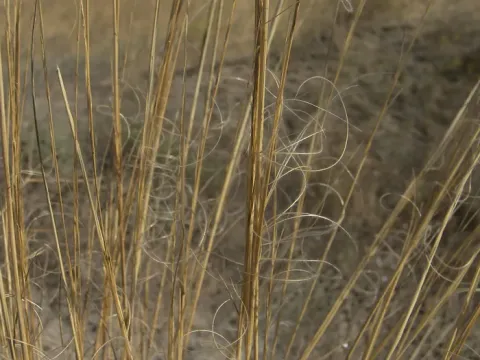
Hohenacker's feather grass
Stipa hohenackeriana
Hohenacker's feather grass (Stipa hohenackeriana) is a perennial herbaceous plant belonging to the Poaceae family, specifically adapted to arid steppe environments.
What the section contains
Hohenacker's feather grass
The plant grows in dense tussocks, which is an evolutionary adaptation to preserve moisture within the root zone during prolonged periods of drought.
Its leaves are typically narrow and rolled, a structural feature that significantly reduces the transpiration rate under intense sunlight and high temperatures.
The natural habitat includes the semi-arid regions of the Caucasus and Central Asia, where it thrives on soils that are often too nutrient-poor for more demanding species.
The plant requires well-drained, sandy, or rocky soils, as it cannot tolerate waterlogging or high levels of soil salinity common in lowland marshy areas.
For optimal results, sowing should be performed in autumn to allow for natural seed stratification, which significantly improves germination rates in spring.
Spring planting is a secondary option, though it requires precise moisture control to protect delicate seedlings from sudden desiccation.
The seeding depth should remain shallow, typically around 1-2 cm, to leverage the plant's natural mechanisms for soil penetration during moisture uptake.
Wide-row spacing is recommended to reduce competition among mature plants and to allow enough space for root system expansion in arid environments.
Successful establishment relies on creating a clean, weed-free seedbed, as young seedlings are poor competitors against invasive, fast-growing weeds.
The commercial yield of Stipa hohenackeriana is relatively low compared to intensive forage crops, which limits its use to extensive pastoral systems.
The primary agricultural value lies in soil stabilization and the restoration of degraded rangelands, where other plants fail to take root.
In terms of forage, it provides moderate nutrition only during the early growth stages before the development of sharp awns which can be injurious to livestock.
Effective management requires rotational grazing strategies to prevent the overgrazing of tussocks, which could lead to irreversible plant mortality.
Beyond direct biomass, the plant serves as a vital component in erosion control, securing topsoil in regions vulnerable to wind and water degradation.
Fungal diseases, particularly rusts and blights, pose a threat during seasons characterized by unusual humidity or stagnant air conditions.
Insects such as stem borers and thrips can cause damage to the panicles, impacting seed production and overall plant health in high-density stands.
Overgrazing remains the most significant threat, leading to the rapid depletion of perennial reserves and the eventual loss of the plant population.
- Fungal rust infections.
- Pest damage to reproductive organs.
- Compaction and destruction by overgrazing.
- Invasion of noxious weeds.
Preventive measures include monitoring field humidity, promoting grazing rotation, and maintaining soil health to support natural immunity against pests.