
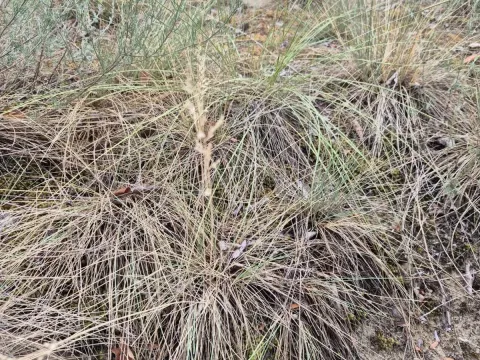
Festuca vaginata
Festuca vaginata
Festuca vaginata belongs to the Poaceae family. It is a perennial grass species that has evolved specific morphological adaptations to thrive in loose, sandy environments and dunes.
What the section contains
Festuca vaginata
The plant is native to Central and Eastern Europe, where it colonizes sandy habitats. It is a pioneer species that helps in stabilizing shifting sands by forming dense root mats.
Botanically, it is recognized by its stiff leaves and a tightly bunched growth habit. This structure minimizes water loss through transpiration, allowing it to survive high solar radiation.
The species requires well-drained, nutrient-poor sandy soils. It is highly intolerant of waterlogging and clay-heavy substrates, which can lead to rapid decay of the root system.
Its primary agricultural and environmental use is in phytoremediation. It is extensively used to prevent aeolian erosion on reclaimed lands, dunes, and infrastructure embankments.
While resistant to many diseases, Festuca vaginata can be susceptible to rust fungi during periods of high humidity, which reduces the vigor of the grass stands.
Powdery mildew may occur in dense or improperly managed plots, though it is generally not a primary threat to the survival of the species in wild populations.
Pests such as soil-dwelling larvae can pose a risk during the establishment phase by feeding on the newly developed root systems of young plants.
Grasshoppers and other orthopterans are common herbivores in its habitat; while they consume foliage, they usually do not threaten the existence of mature stands.
The greatest threat remains habitat degradation due to human activities, including overgrazing and trampling, which expose the soil and disrupt the plant's stabilization role.