
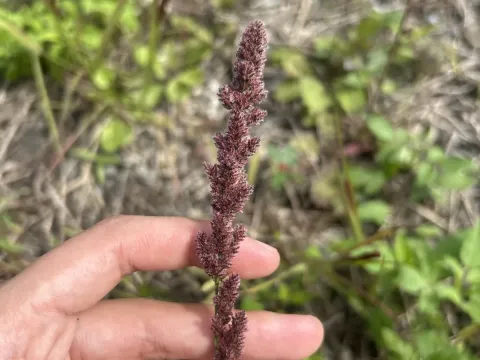
Gophertail lovegrass
Eragrostis ciliaris
Gophertail lovegrass is a heat-loving grass species belonging to the Poaceae family. Optimal sowing times coincide with periods when soil temperatures consistently remain above +18°C, ensuring rapid germination.
What the section contains
Gophertail lovegrass
In tropical and subtropical regions, sowing is typically initiated at the beginning of the rainy season, which provides the essential moisture for the seeds to establish. Seeds are sown using surface techniques or at a minimal depth due to their tiny size.
The species exhibits a fast initial growth rate when provided with adequate light. Sowing schedules must account for moisture cycles, as young seedlings are particularly vulnerable to desiccation during their first two weeks of life.
When used as a pasture grass, oversowing into existing stands is possible at the start of the warm season. It is crucial to avoid overcrowding to ensure each plant receives enough sunlight for healthy tillering.
For industrial fodder production, row sowing with 30-centimeter spacing is recommended. This layout facilitates field maintenance and reduces intra-specific competition, allowing for more uniform biomass development.
Native to tropical regions in Africa and Asia, Eragrostis ciliaris is highly demanding in terms of thermal conditions. It has very low frost tolerance and thrives best in open, sun-drenched environments.
The species is quite adaptable regarding soil types but achieves the highest productivity levels on light, sandy, or sandy-loam soils. Its high drought tolerance makes it a viable candidate for cultivation in arid zones.
The plant demonstrates success even on nutrient-poor soils where other fodder grasses fail to produce adequate biomass. Nevertheless, minimal nitrogen fertilization significantly boosts green matter yields.
Gophertail lovegrass cannot tolerate prolonged waterlogging or poor drainage. Proper soil permeability is a critical factor for success, especially in areas characterized by heavy seasonal rainfall.
As a light-loving plant, it reacts negatively to shading by other vegetation. Effective agrotechnical management requires maintaining high light levels to prevent stem elongation and the resulting decline in nutritional quality.
Economic use of gophertail lovegrass centers on green biomass production for livestock grazing and hay harvesting. Under favorable conditions, multiple cuts per season are possible due to the plant's robust regenerative capacity.
Biomass yield is directly correlated with insolation levels and moisture availability during the active growing phase. Despite being a relatively short grass, its dense turf formation allows for significant forage output per hectare.
Seeds are also utilized as an supplementary food source for birds, valued for their carbohydrate and micronutrient profile. This makes the plant a versatile component in diverse agricultural livestock rations.
During intensive grazing, managing stocking rates is essential to prevent soil exposure and overgrazing. The plant recovers quickly if the root system remains undamaged through moderate grazing cycles.
The economic efficiency of Eragrostis ciliaris is rooted in its low-input requirements. Minimal investment in traditional agrotechnical measures often offsets its moderate yield compared to highly selected ryegrass varieties.
The primary threats to this crop include fungal diseases, which thrive under high humidity conditions. Rust diseases are particularly problematic, as they damage foliage and significantly reduce overall forage quality.
Insect pests such as aphids and various leafhoppers pose the most significant danger, as they feed on plant sap and may act as vectors for viral cereal diseases.
When pest or pathogen outbreaks occur, timely harvesting of the green biomass is recommended to remove infected tissue and stimulate healthy regrowth in the subsequent cycle.
Weed competition represents a major threat during the early seedling stage. Because gophertail lovegrass is slow to establish, proactive weed management or herbicide applications during the initial growth phase are mandatory.
Crop rotation is vital for disease prevention. It is advised to avoid planting this species on land where previous grasses from the Poaceae family have shown symptoms of root rot or systemic pathogens.
Harvesting for hay should be performed at the onset of flowering, as this is when the protein content in the stems is at its peak. Delaying harvest leads to stem lignification and a sharp decrease in forage digestibility.
For seed production, harvesting should take place when the inflorescences darken. Because the seeds are extremely small, specialized harvesting equipment with fine-mesh screens is required to prevent significant post-harvest losses.
Drying of the cut material is typically handled in the field under sunny conditions. Due to the fine stems, the drying process is relatively efficient, reducing the window of risk for nutrient loss from rainfall.
In pasture systems, implementing a rotational grazing schedule is key to longevity. Optimal grazing intervals allow the stand to maintain high density for several years of field operation.
After harvest, stubble residue serves as an excellent mulch. This helps prevent soil erosion and aids in moisture retention, which is critical for long-term productivity in hot climates.