
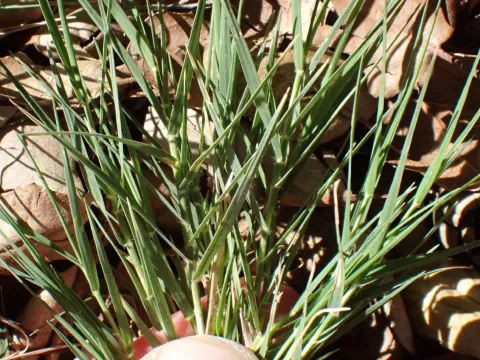
Distichlis stricta
Distichlis stricta
Distichlis stricta, commonly known as saltgrass, is a perennial herbaceous plant belonging to the Poaceae family. It is a true halophyte, biologically specialized to thrive in environments with high concentrations of sodium and other salts that would prove fatal to most conventional crops.
What the section contains
Distichlis stricta
The plant's natural range is primarily within western North America, where it colonizes salt marshes, saline meadows, and the margins of alkaline lakes. Its evolutionary adaptations allow it to maintain cellular integrity under severe osmotic pressure.
Botanically, it features an extensive subterranean rhizome system, which forms a dense, durable sod. The aerial stems are stiff and upright, while the leaves are narrow, tough, and often coated with a waxy cuticle to prevent water loss through transpiration.
Optimal growth requires high solar radiation and well-drained but moist soils. While it exhibits extreme drought tolerance, its biomass production increases significantly when the roots have access to saline groundwater or moisture from sub-surface layers.
Agronomic establishment usually involves vegetative propagation using rhizome segments, as seed germination can be erratic in field conditions. Once established, the culture serves as a vital component in the biological reclamation of degraded saline landscapes.
The primary agricultural use of Distichlis stricta is as a forage source on saline lands that are otherwise unproductive. While it may not match high-input grasses in protein content, it provides critical grazing opportunities where no other forage can survive.
Utilizing this species for grazing allows land managers to derive economic value from salt-affected areas. Livestock grazing on saltgrass-dominated pastures adapt to the high mineral intake, utilizing the plant as a resilient subsistence food source.
Productivity is managed through rotational grazing to prevent overgrazing, which could compromise the rhizome mat. When managed sustainably, the stand provides a consistent, albeit modest, annual yield of dry matter that can sustain herds during seasonal forage shortages.
Beyond forage, the plant is highly valued for its soil-binding properties. The dense rhizomatous network acts as a physical barrier against wind erosion and soil drifting in arid, open landscapes, preserving the existing soil structure.
It also serves a niche purpose in ecological restoration and coastal landscaping. Its ability to withstand salt spray and heavy metal-laden soils makes it an ideal candidate for stabilizing slopes in environments where chemical treatments are impractical.
Distichlis stricta is remarkably resistant to most plant diseases. Pathogenic issues are typically restricted to instances of waterlogging, which can induce fungal root rot. Ensuring adequate soil drainage is the most effective preventative measure.
Pest pressure is generally low due to the high saline content of the plant tissues, which acts as a natural deterrent against many generalist insect herbivores. Localized infestations of grasshoppers represent the most common biological threat.
Competition from invasive weeds is generally non-existent once the saltgrass stand has reached maturity. Its aggressive rhizomatous spread effectively crowds out other opportunistic plant species, maintaining a monoculture of high ecological stability.
Mechanical damage from heavy equipment can be detrimental to the rhizome structure, leading to gaps in the sod. Restoration of damaged areas is best achieved by avoiding tillage and allowing natural rhizome expansion during the peak growing season.
While the species is hardy against temperature extremes, severe winter dormancy is typical. The plant survives deep freezes by retreating to its root system, resuming growth rapidly once thermal conditions return to the required levels.