
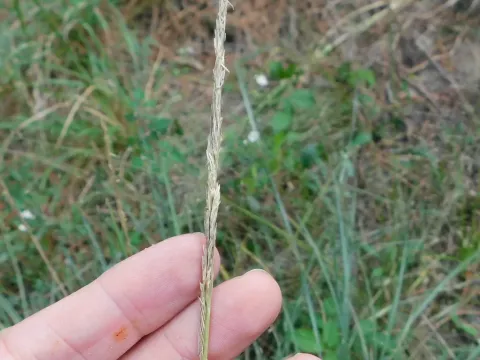
Dropseed
Sporobolus
Sowing of Sporobolus is preferably carried out in the spring when soil temperatures reach 12–15°C. The optimal time is during a period with minimal risk of late frosts to ensure uniform germination.
What the section contains
 Alkali sacaton
Sporobolus airoides (Torr.) Torr.
Alkali sacaton
Sporobolus airoides (Torr.) Torr.
 Giant dropseed
Sporobolus fimbriatus (Trin.) Nees
Giant dropseed
Sporobolus fimbriatus (Trin.) Nees
 Giant sacaton
Sporobolus wrightii Munro ex Scribn.
Giant sacaton
Sporobolus wrightii Munro ex Scribn.
 Prairie dropseed
Sporobolus heterolepis (A. Gray) A. Gray
Prairie dropseed
Sporobolus heterolepis (A. Gray) A. Gray
 Sand dropseed
Sporobolus cryptandrus (Torr.) A. Gray
Sand dropseed
Sporobolus cryptandrus (Torr.) A. Gray
 Seashore dropseed
Sporobolus virginicus (L.) Kunth
Seashore dropseed
Sporobolus virginicus (L.) Kunth
 Smut grass
Sporobolus indicus (L.) R. Br.
Smut grass
Sporobolus indicus (L.) R. Br.
 Sporobolus aculeatus
 (L.) P. M. Peterson
Sporobolus aculeatus
Sporobolus aculeatus (L.) P. M. Peterson
 Sporobolus diandrus
 (Retz.) P. Beauv.
Sporobolus diandrus
Sporobolus diandrus (Retz.) P. Beauv.
Dropseed
When seeding, the seeds are planted at a shallow depth, usually no more than 1–2 centimeters, as small seeds require good contact with moist substrate.
For establishing pastures or hayfields, a row-seeding method is preferred, which facilitates easier mechanical maintenance of the crops during the growing season.
A crucial condition is thorough pre-sowing soil preparation, including leveling and firming the surface to ensure even seed distribution.
In regions with arid climates, sowing is shifted to the early spring to utilize the maximum amount of accumulated winter moisture for the development of the root system.
Sporobolus belongs to the Poaceae family and is known for its high ecological plasticity, allowing it to grow on poor, sandy, and even saline soils.
The crop prefers well-lit areas as it is a sun-loving plant and performs poorly under heavy shade from other tall-growing species.
The plant possesses outstanding drought resistance, making it a valuable component in grass mixtures in arid regions where other grasses fail to survive.
Sporobolus is not demanding regarding soil texture, but it develops most productively on well-drained loams, avoiding areas with prolonged water stagnation.
Optimal soil acidity for this crop ranges from pH 6.0 to 7.5, although the species is capable of adapting to more specific environmental conditions.
The agricultural value of Sporobolus lies in its ability to form a dense sod, providing soil protection against erosion, which is especially important on slopes.
As a forage crop, Sporobolus provides high-quality green mass, which is readily grazed by livestock in early growth stages before the stems become coarse.
The yield of green mass depends directly on the level of nitrogen nutrition and moisture availability during the active tillering and stem elongation phases.
When used as a hay crop, it is important to observe mowing times to achieve the maximum output of nutrients and ensure vigorous regrowth of the aftermath.
Under irrigated farming conditions, the productivity of Sporobolus increases significantly, allowing for multiple cuttings within a single growing season.
The main threats to Sporobolus crops are typical diseases for grass species, such as leaf rust and various types of smut.
Pests that affect grasses, including wireworms and grass flies, can cause significant damage to young crops in the seedling phase.
Yield reduction often occurs due to competition with weeds during early growth stages, making weed control crucial before canopy closure.
For the prevention of fungal infections, crop rotation is recommended, and overly dense stands that hinder air circulation should be avoided.
If pests are widespread, authorized insecticides are used, but the primary method of control remains the agrotechnical maintenance of stand health.
Harvesting Sporobolus for hay is performed during the heading stage, as this is when the balance between nutrient content and biomass volume is optimal.
For seed production, harvesting is carried out upon reaching full maturity, when the panicles develop their characteristic color and natural seed shedding begins.
Standard mowers are used for cutting, with a cutting height of 5–7 centimeters to ensure rapid regrowth of the next crop.
The harvested mass must be dried in a timely manner to a moisture content of no more than 15-17 percent to prevent molding and the loss of feed quality.
Post-harvest seed processing includes cleaning from impurities and drying to standard moisture levels, which guarantees high germination rates for future seasons.