
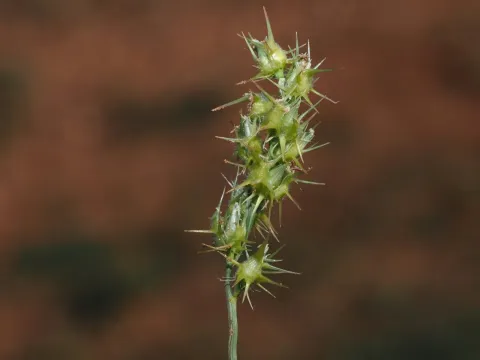
Longspine sandbur
Cenchrus spinifex
Longspine sandbur is an invasive, non-crop species that germinates primarily in late spring when soil temperatures reach 12–15°C.
What the section contains
Longspine sandbur
Seedlings emerge in several flushes during the growing season, especially after rainfall events that keep the upper soil profile moist.
Because the seeds are equipped with sharp spines, they can persist in the soil for several years, making infestation control a long-term challenge.
Successful germination occurs even in dry soil conditions, which gives this weed a significant competitive edge over most commercial crops.
Monitoring for seedling emergence should begin as soon as spring temperatures stabilize to allow for early intervention before spikelets form.
Belonging to the Poaceae family, this plant is remarkably well-adapted to sandy and disturbed soils, commonly found in pastures, roadsides, and agricultural fields.
It thrives in full sunlight and is extremely drought-tolerant, allowing it to dominate areas where other vegetation struggles to survive.
The plant originates from the Americas but has become a significant weed problem across temperate and subtropical regions worldwide.
Soil structure, specifically sandy or loose loamy textures, is highly conducive to its rapid growth and deep root system establishment.
Its ability to tolerate low-nutrient soils makes it a formidable colonizer in abandoned or poorly managed agricultural lands.
The primary threat posed by this plant is its sharp, barbed burs, which cause severe physical injury to the mouths and hides of grazing livestock.
As a highly competitive weed, it consumes significant resources, resulting in reduced yields and nutrient depletion in crop fields.
The presence of burs in harvested grain significantly lowers the quality and marketability of agricultural products.
Management requires a mix of mechanical cultivation, chemical control using pre-emergence herbicides, and strict field sanitation practices.
- Mechanical removal before seed head maturation
- Application of specialized herbicides
- Crop rotation to break the life cycle
- Rigorous quarantine of equipment moving from infested areas