
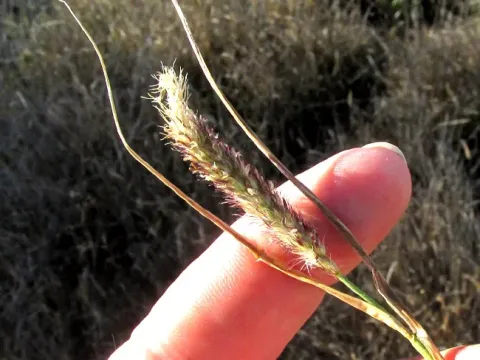
Cenchrus pilosus
Cenchrus pilosus
Cenchrus pilosus thrives as a warm-season grass, requiring soil temperatures to reach at least 15-18 degrees Celsius before sowing. Planting in cold, damp soil will significantly delay germination and increase the risk of seed decay.
What the section contains
Cenchrus pilosus
The seeds should be planted at a shallow depth of 2-3 centimeters. A well-prepared seedbed that is firmed with a roller ensures the necessary soil-to-seed contact required for consistent emergence.
For forage production, sowing in rows spaced 15-20 centimeters apart is recommended to establish a thick, uniform stand. Seed production crops benefit from wider spacing of 45-60 centimeters to facilitate maintenance.
Weed management is critical during the seedling stage, as Cenchrus exhibits slow early growth. Ensure the field is thoroughly cleared of perennial weeds before sowing to prevent early competition.
Seeding rates should be adjusted based on seed purity and local soil conditions. Using high-quality, certified seeds is the best strategy to ensure a healthy and uniform pasture establishment.
##requirements##This grass prefers light-textured, well-draining soils such as sandy loams. Heavy clay soils that tend to compact or waterlog should be avoided as they inhibit root respiration and growth.
Being a heliophilous (sun-loving) plant, Cenchrus pilosus demands full sun exposure throughout the day. It is highly adapted to hot, arid climates where other forage grasses might struggle to survive.
While known for its drought tolerance, the crop responds positively to irrigation. Supplying water during peak growth stages can double or triple the total annual biomass production.
The ideal soil pH range for this crop is between 6.0 and 7.5. Soils that are too acidic may require liming to ensure optimal nutrient uptake, particularly for nitrogen and phosphorus efficiency.
Regular nitrogen fertilization is necessary for intensive forage systems. Applying fertilizer after each cutting helps the grass recover quickly and maintains high protein levels in the regrowth.
Under favorable conditions and with proper irrigation, Cenchrus pilosus can produce multiple cuts per season, with total yields reaching 30 to 45 tons of green mass per hectare.
Annual yields remain stable over several years if proper maintenance is provided. Yearly harrowing of the stand helps break up the soil crust and encourages secondary tillering.
Seed production yields generally range from 0.6 to 1.0 tons per hectare. Harvesting should be carefully timed to match seed maturity, as the seeds have a tendency to shatter when overly ripe.
The nutritional profile of this grass is well-regarded in livestock farming, providing a reliable source of fiber and moderate protein levels for ruminants like cattle and sheep.
Productivity typically peaks in the third or fourth year as the root system matures, allowing the plant to explore a larger soil volume for water and essential nutrients.
Common diseases affecting this species include rusts and smuts, which often emerge during prolonged periods of high humidity. Proper field sanitation and airflow management can mitigate these risks.
Pests such as aphids and various species of stem-boring flies can cause significant damage to young plants. Early monitoring and integrated pest management (IPM) are essential for successful yields.
Weed infestation is the primary threat in the establishment year. The use of selective herbicides, where permitted, can protect the stand until the grass is robust enough to shade out competitors.
Winter dormancy provides protection, but severe rodent damage to the crowns can cause patchiness in the stand the following spring. Trapping or perimeter control may be necessary in infested areas.
Poor drainage during heavy rainfall events can lead to root rot. Ensuring the field has adequate surface drainage is vital for long-term stand longevity and overall plant health.
The optimal time to harvest for hay is at the boot stage, just before the seed heads fully emerge. This timing provides the best balance between total biomass weight and nutritional quality.
When harvesting for silage, ensure the forage is wilted to approximately 30 percent dry matter. This moisture level is ideal for successful fermentation in silos or baled storage.
After each cut, the field should be left to recover until regrowth reaches the boot stage again. Avoid overgrazing or cutting too short, as this reduces the plant's ability to regenerate.
The final cut of the season must be timed to allow at least 30-40 days of growth before the first frost. This allows the plants to store carbohydrates in the crown for winter survival.
Equipment should be set to maintain a 5-7 centimeter stubble height. This practice protects the growing points of the plant, ensuring rapid regrowth for subsequent harvests in the following season.