
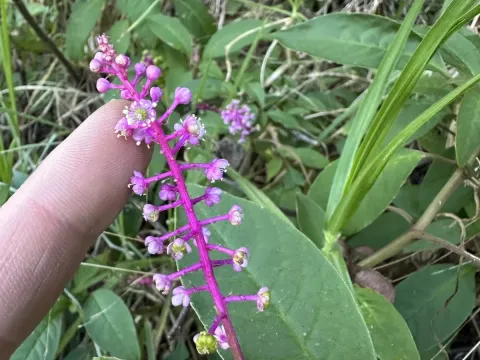
Phytolacca rivinoides
Phytolacca rivinoides
Sowing seeds of Phytolacca rivinoides is typically carried out in controlled environments or greenhouses in early spring to ensure a sufficiently long growing season. In tropical regions, year-round sowing is feasible provided that high humidity levels are maintained.
What the section contains
Phytolacca rivinoides
The seeds possess a dense seed coat, which often necessitates scarification or stratification to improve germination rates. Seeds should be planted at a depth of no more than 1 to 2 centimeters to ensure adequate oxygen access for the developing embryo.
Once seedlings emerge, they are pricked out into individual pots after the development of the first true leaves. Transplanting into the open field should only occur once the risk of frost has passed, as this plant is highly sensitive to cold temperatures.
Planting schemes must account for the plant's vigorous growth, as it can reach heights of up to two meters. A spacing of at least 80 to 100 centimeters between plants is recommended to ensure proper airflow and light penetration.
Vegetative propagation via cuttings is also an effective method, allowing for faster development of mature specimens while maintaining the desirable characteristics of the parent plant.
Phytolacca rivinoides belongs to the Phytolaccaceae family and is a typical tropical species. It thrives in well-drained, fertile loamy soils with a neutral to slightly acidic pH level.
The culture is highly light-demanding; however, in regions with extremely high temperatures, it requires partial shading to prevent leaf scorch. In temperate climates, the plant must be kept in greenhouses or provided with heavy protection during winter months.
A critical condition for successful cultivation is maintaining high soil moisture without causing waterlogging, which often leads to root rot. Careful irrigation management is necessary to keep the root system healthy.
The plant responds well to organic fertilization during the active growing phase. Regular nitrogen-based supplements promote the development of robust green mass, which is essential for the production of large floral racemes.
In its natural habitat, this plant is found along forest edges and in secondary growth, meaning it is well-adapted to competition and benefits from morning shade in diverse planting environments.
The agricultural use of Phytolacca rivinoides is primarily focused on the extraction of biomass for the pharmaceutical industry. The plant contains specific phytotoxins and proteins that are subjects of interest in modern biomedical research.
Yield of the aerial part of the plant depends heavily on agricultural practices and local climatic conditions. Under intensive cultivation regimes, high biomass productivity can be achieved per unit of land area.
Harvesting is conducted during the peak flowering phase, as the concentration of biologically active compounds in the leaves and shoots reaches its maximum at this stage. Timing is determined by the development stage of the flower clusters.
After initial processing, the raw material is dried under controlled temperature conditions to preserve its biochemical integrity. Proper drying protocols significantly extend the shelf life of the harvested product.
Beyond its pharmaceutical value, the plant is increasingly utilized as an ornamental species in tropical landscaping, where its unique racemes and dark berries provide a significant visual impact.
The primary threats to Phytolacca rivinoides are fungal infections, often triggered by high humidity and poor air circulation. Powdery mildew and various leaf spot diseases are the most common pathogens affecting the foliage.
Pests such as spider mites and aphids frequently attack young shoots, particularly in greenhouse settings. Management strategies include both biological control methods and the use of systemic insecticides during severe infestations.
Slugs and snails can cause significant damage to young plants by feeding on the tender leaves. Installing physical barriers or applying mulch helps mitigate the impact of these pests in the root zone.
Failure to implement proper crop rotation leads to the accumulation of soil-borne pathogens, making the plants more susceptible to viral infections. It is advised to avoid planting on sites previously used for other Solanales species.
Disease prevention is best achieved through regular sanitary pruning and the prompt removal of decaying plant matter, which prevents the spread of fungal spores and decay-causing bacteria within the dense canopy.