
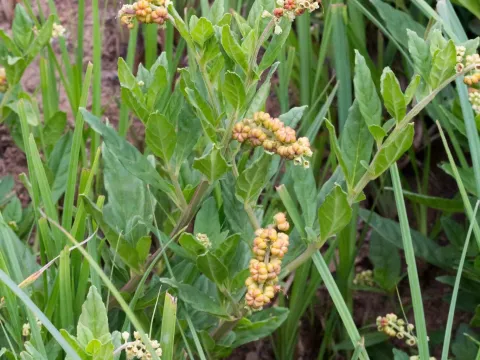
Phytolacca heptandra
Phytolacca heptandra
Sowing Phytolacca heptandra requires high-quality seeds, which benefit from stratification to improve germination rates. The ideal time for sowing is early spring when soil temperatures stabilize at 10-12 degrees Celsius.
What the section contains
Phytolacca heptandra
Seeds should be planted at a depth of 2 to 3 centimeters to ensure adequate contact with moist soil while protecting them from rapid surface drying.
For large-scale cultivation, precision seed drills are recommended, maintaining row spacing of at least 70 centimeters to allow for plant expansion and future mechanical maintenance.
Seedlings can be started in greenhouses and transplanted when they reach a height of 10-15 centimeters, which ensures a more uniform stand and reduces field losses.
Regular irrigation during the initial establishment phase is crucial for developing a strong root system, which is essential for the plant's long-term productivity.
Phytolacca heptandra, a member of the Phytolaccaceae family, thrives in fertile, well-drained loamy soils with a near-neutral pH value.
The crop demands full sun exposure to optimize the synthesis of active biological compounds within its tissues, making site selection critical for commercial success.
It requires consistent moisture but is sensitive to waterlogging; therefore, land should be well-drained, avoiding areas prone to flooding or high groundwater tables.
Organic matter enrichment is highly beneficial, and incorporating compost or well-rotted manure before planting significantly enhances soil structure and nutrient availability.
While hardy, the plant benefits from mulch protection in regions with harsh winters, as extreme cold can damage the top layers of the soil where the rhizomes reside.
The yield of Phytolacca heptandra increases progressively as the plant matures, typically reaching peak productivity from the third year of growth onwards.
Optimal nitrogen and potassium applications during the vegetative growth stage are necessary to maximize the production of foliage and root biomass.
Commercial harvesting is typically cyclical, where roots are extracted once the plant has reached a certain maturity level to ensure sufficient quality and volume.
Yield consistency relies heavily on maintaining optimal plant density; overcrowding can lead to reduced individual plant health and lower overall harvest quality.
Modern agronomic practices, including balanced fertilization and timely irrigation, contribute to stabilizing yields across different climatic conditions.
The main threats to the crop include aphids and various leaf-feeding insects that can affect foliage health during the active growing season.
Fungal diseases are the primary concern, often triggered by excessive humidity or poor soil drainage, which can lead to root rot if left unmanaged.
Preventative measures, such as maintaining proper plant spacing for airflow and following a strict crop rotation schedule, are essential to minimize disease outbreaks.
Biological pest control methods are preferred, especially when the crop is intended for pharmaceutical use, to avoid harmful chemical residues in the raw material.
Regular monitoring of fields allows for early detection of potential threats, enabling swift and targeted intervention before damage becomes economically significant.
Harvesting usually takes place in late autumn after the plant has entered dormancy and the aerial parts have started to senesce.
Mechanical harvesting of rhizomes requires deep-reaching equipment to minimize damage to the root system, ensuring the product retains its high-quality standard.
Post-harvest handling involves thorough cleaning and washing to remove soil particles, followed by cutting the roots into uniform sizes to facilitate drying.
Drying must be conducted in controlled environments with adequate ventilation to prevent mold growth and maintain the potency of the chemical constituents.
Storage of the finished product requires cool, dry conditions away from direct sunlight to preserve the pharmacological integrity of the harvested material.