
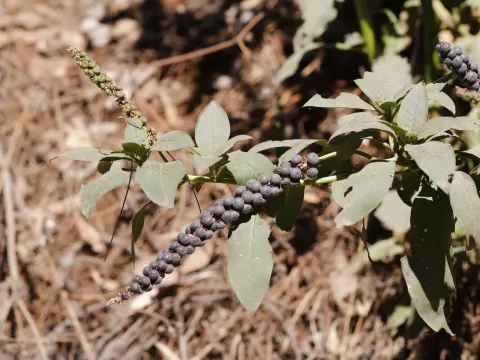
Chile pokeweed
Phytolacca chilensis
Sowing of Chile pokeweed (Phytolacca chilensis) is best conducted in the autumn season or early spring following a necessary stratification period for the seeds. The seeds are protected by a thick coat, which makes pre-sowing preparation vital for germination success.
What the section contains
Chile pokeweed
The optimal planting depth is approximately 1.5 to 2 centimeters. Maintaining consistent moisture in the upper soil layer is crucial during the germination phase to ensure a high rate of seedling establishment.
For commercial agricultural production, a row-cropping pattern is recommended, maintaining a distance of 60 to 70 centimeters between rows. This spacing allows for efficient mechanical weeding and cultivation processes.
Seedlings may emerge gradually, requiring careful management during the initial stages. Weed control is essential during the first year, as young plants are vulnerable to competition for light and soil nutrients.
The ideal temperature range for germination is between +15 and +20 degrees Celsius. Sowing in cold or waterlogged soil should be avoided, as it significantly increases the risk of seed decay due to soil-borne pathogens.
Chile pokeweed belongs to the Phytolaccaceae family and thrives in areas with full sun exposure, although it exhibits tolerance for partial shade during peak sunlight hours.
The crop requires highly fertile, well-drained loamy or sandy loam soils. A neutral to slightly acidic pH is optimal for the rapid expansion of its large, fleshy root system.
While the plant requires sufficient moisture for vigorous growth, it is sensitive to waterlogging. Ensuring proper soil drainage is critical to prevent root rot and other moisture-related disorders.
Consistent applications of nitrogen and potassium fertilizers support the rapid development of the plant's biomass. Incorporating organic matter, such as compost, during autumn tillage significantly improves the structural integrity of the soil.
The plant demonstrates good adaptability to moderate climates, though in regions with severe, snowless winters, mulching the root zone with straw or peat is recommended to protect the crown and prevent frost damage.
The primary economic product of Chile pokeweed is its root system, which is highly valued in the pharmaceutical industry for its active compounds. Yield is heavily dependent on plant age and overall field management.
The roots typically reach their peak mass and concentration of active ingredients by the third or fourth year of cultivation. This period is the optimal time for harvesting the medicinal raw material.
Under intensive management, yield levels can reach several tons of dried root material per hectare, providing a viable financial return for agricultural producers.
The berries also possess commercial value and are harvested at full physiological maturity, when they exhibit their characteristic deep purple or black pigmentation.
To maximize yield, growers should focus on maintaining optimal plant density and ensuring timely access to irrigation, particularly during the critical developmental stages in early summer.
Chile pokeweed is generally robust, but it can be susceptible to disease if agronomic standards, particularly irrigation and drainage, are neglected. Excess humidity is the primary risk factor for plant health.
Pests are generally not a significant threat, though mollusks like slugs and snails may target young foliage during humid or rainy weather conditions, potentially damaging the aesthetic quality of the crop.
- Fusarium root rot (caused by water stagnation).
- Slugs and snails (leaf-feeding pests).
- Powdery mildew (in overcrowded or poorly ventilated fields).
- Rodent damage during winter months.
Preventative measures include maintaining proper inter-row spacing to facilitate air circulation and employing strict crop rotation practices to minimize the buildup of soil pathogens.
Biological control agents are preferred over chemical pesticides to maintain the purity of the medicinal product, as systemic chemical residues can be detrimental to the end-use quality.
Harvesting the root system is performed in the autumn after the above-ground parts have died back. This timing ensures that nutrient concentration in the roots is at its maximum level.
Heavy machinery such as deep-digging plows or harvesters is utilized to extract the roots, which are then cleaned of soil and debris before processing.
The raw roots are washed with water, cut into uniform pieces to facilitate drying, and processed in controlled-temperature dryers to preserve the integrity of their bioactive compounds.
Berry harvesting is conducted manually as they ripen. Due to the high juice content, the fruit is perishable and must be handled with care to prevent bruising and degradation.
Correct storage conditions for the final dried product include cool, dry, and dark environments to prevent moisture absorption and maintain the chemical stability of the botanical extract.