
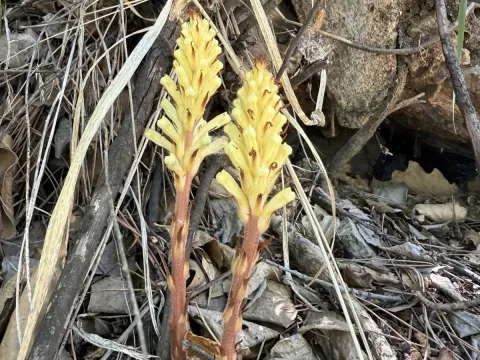
Dense-spike broomrape
Orobanche pycnostachya
Dense-spike broomrape (Orobanche pycnostachya) is a parasitic plant species belonging to the family Orobanchaceae. As a holoparasite, it lacks chlorophyll and relies entirely on host plants for its nutritional requirements.
What the section contains
Dense-spike broomrape
It is primarily found in arid and semi-arid regions where it targets specific host plants. The distribution is closely linked to the availability of suitable hosts and environmental factors like soil temperature and moisture levels.
Botanically, it emerges from the soil only after establishing a connection to the host roots through specialized organs called haustoria. This connection allows it to extract water and nutrients directly from the host's vascular system.
The lifecycle is triggered by specific chemical exudates released by the roots of the host plant. These compounds induce the germination of broomrape seeds, which are extremely small and can remain dormant in the soil for a long time.
Ecological requirements for its success include well-drained soils and a consistent presence of the host crop, which facilitates the spread and continuous infestation of agricultural areas over successive seasons.
The primary agricultural threat posed by Orobanche pycnostachya is the severe reduction in crop yield. By siphoning off resources, the parasite weakens the host, often leading to total crop failure in heavily infested patches.
Crop rotation with non-host plants is the most effective management strategy to break the life cycle of the broomrape. This prevents the buildup of seeds in the soil over time.
Integrated weed management includes the use of herbicide-resistant crop varieties or chemical treatments that target the parasite during the attachment phase to the roots.
Sanitation practices are essential, including the cleaning of farm machinery and the use of certified seed lots, to prevent the mechanical dispersal of microscopic seeds across fields.
Biological control research and the breeding of resistant plant varieties continue to be the main focus of agricultural science in managing this persistent parasitic threat.