
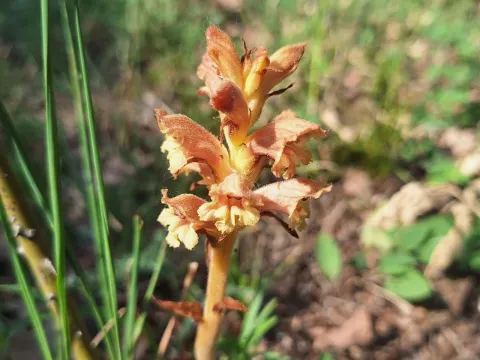
Germander broomrape
Orobanche teucrii
Germander broomrape (Orobanche teucrii) is an obligate holoparasitic plant belonging to the Orobanchaceae family. Unlike conventional crops, it is a botanical entity that derives all its nutrients and water from host plants, specifically within the Teucrium genus.
What the section contains
Germander broomrape
Lacking chlorophyll entirely, this plant cannot perform photosynthesis. It relies on a specialized root-like attachment structure known as a haustorium, which penetrates the host plant's vascular system to extract necessary photosynthetic products, minerals, and water for its growth and reproduction.
Its natural habitat is primarily distributed across Central and Southern Europe. The plant flourishes in sun-drenched, well-drained calcareous soils, which provide the optimal environment for the presence of its host species. These ecological niches are typically found in meadows and rocky terrain.
The survival strategy of Orobanche teucrii revolves around long-lived, microscopic seeds. These seeds remain dormant in the soil for extended periods and will only germinate upon sensing specific chemical signals (strigolactones) released by the roots of a compatible host plant.
Agricultural interest in this species lies largely in its role as a botanical model for studying parasitic interactions. Understanding its life cycle helps researchers develop management strategies for more economically destructive broomrape species that parasitize major global food crops.
The primary threat to the lifecycle of Germander broomrape is the absence of host plants. If the seeds germinate in soil lacking a suitable Teucrium host, the seedling will exhaust its limited energy stores and die within a few days, failing to establish a successful infection.
Natural pests, such as specialized insects (including certain dipteran larvae), feed on the fleshy stems and capsules of the broomrape, significantly reducing its seed set. Additionally, fungal pathogens can compromise the structural integrity of the plant during periods of high humidity.
Management in field settings involves careful crop rotation and the strategic use of trap crops. By planting non-host species, agronomists can effectively trigger the germination of broomrape seeds while denying them the host connection necessary to complete their life cycle.
Physical removal of the inflorescences before seed maturation is critical to preventing the spread of the tiny, wind-dispersed seeds. This manual control method is highly effective for reducing the overall seed bank in controlled environmental settings or small garden plots.
- Monitor host population health.
- Implement rigorous soil management.
- Avoid movement of contaminated soil.
- Use selective biological control agents.
- Apply germination stimulants during fallow periods.