
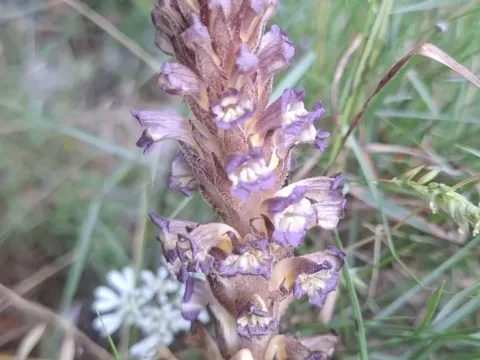
Orobanche grenieri
Orobanche grenieri
Orobanche grenieri is an obligate root parasitic plant belonging to the Orobanchaceae family. As a holoparasite, it lacks chlorophyll and cannot perform photosynthesis, which makes it entirely reliant on the host plant for water, minerals, and carbon compounds.
What the section contains
Orobanche grenieri
The morphology of this plant is specialized for attachment. It produces haustoria that penetrate the root tissues of the host, establishing a physical and functional link that drains the host's resources, ultimately leading to yield losses and weakened plant health.
The life cycle is synchronized with the growth of host plants. The seeds remain dormant in the soil for years and germinate only when they detect specific chemical signals in the rhizosphere, ensuring that the parasite emerges in close proximity to a compatible food source.
This species is predominantly found in Mediterranean ecosystems. It thrives in well-drained soils and warmer climates, often appearing in agricultural fields where management practices have not been adjusted to prevent the accumulation of parasitic seeds in the soil profile.
Management of this parasite is complex and requires integrated strategies. Current agricultural best practices focus on the use of resistant host cultivars, careful crop rotation to starve the parasite, and the application of chemical control agents targeting the germination phase of the weed.